


















Anthony Edwards Stats Highlight Scoring Peak but Spotlight Defensive Shortfalls for Timberwolves

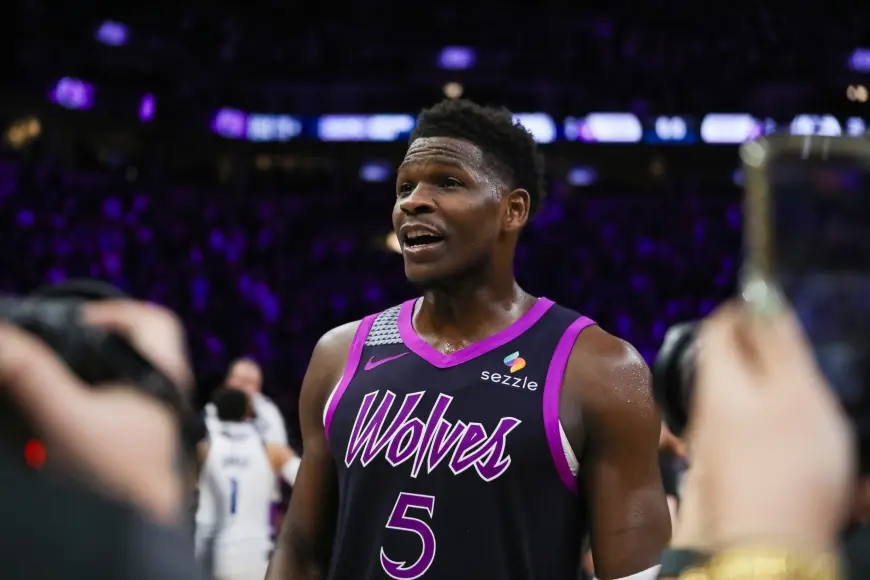
The latest look at anthony edwards stats underlines a player whose scoring and playoff resume vault him into superstardom, even as those same numbers arrive alongside persistent defensive concerns that matter with 26 games left in the season. The tension between Edwards’ individual production and the Timberwolves’ uneven results has pushed coaches and columnists to demand clearer leadership and tougher on-court responses.
Anthony Edwards Stats and Defensive Questions
Edwards, 24, has compiled a body of work that includes eight playoff series appearances and back-to-back Western Conference Finals runs in 2023-24 and 2024-25, placing him at the center of Minnesota’s turnaround. The raw anthony edwards stats that night-to-night fans notice — scoring outputs, improved three-point and midrange shooting, and clutch-time efficiency — have been accompanied by defensive lapses that coaches say suppress the team’s ceiling.
On Feb. 22, in a 135-108 loss to Philadelphia, Edwards produced 28 points, nine rebounds and three assists, yet he also committed seven turnovers and failed to consistently contest perimeter shots while being dunked on by Tyrese Maxey, who finished with 39 points. Those game-level figures illustrate a recurring cause-and-effect pattern: when Edwards presses offensively but yields on defense, the Wolves’ overall defensive performance suffers and the team loses margin in tight matchups.
Coach Chris Finch on Team Health and Ayo Dosunmu Trade
Head coach Chris Finch has framed the situation around internal expectations and roster balance. Entering the All-Star break the Timberwolves sat sixth in the Western Conference in the 2025-26 campaign, the same place they finished the previous regular season. Finch flagged inconsistency on defense as a central problem and said the club had been relatively healthy but not capitalizing on young depth.
Finch pointed to the recent trade for Ayo Dosunmu as a move intended to bolster bench strength. He also emphasized timeline urgency: with 26 games left — roughly one-third of the season — Finch told Edwards he has “the capacity to be the best two-way player in the league” and needs to "lean in and lead us in that way. " The implied effect is straightforward: improved individual defense from Edwards would materially change Minnesota’s defensive rating and its playoff positioning.
Souhan: Leadership, the Feb. 22 Loss, and What Comes Next
Columnist Jim Souhan has urged Edwards to translate talent into a more forceful on-court persona. Souhan’s critique stems largely from the Feb. 22 game against a depleted 76ers squad that lacked Joel Embiid and Paul George while the Wolves were missing Rudy Gobert and Naz Reid. Despite those absences, Philadelphia’s victory exposed Minnesota’s failures to contest three-point shots and to protect the ball early in the game.
Souhan argued that Edwards must demand more from teammates and himself, suggesting that moments of physical response and authoritative leadership are part of the maturation required for an MVP or title run. The column notes how displays of intensity could change opponents’ behavior; for instance, when Tyrese Maxey dunked on Edwards and stared him down, the moment signified a leadership gap in the eyes of critics. What makes this notable is how quickly elite offensive progress can be undercut by lapses that are quantifiable in turnovers, missed contests and swings in opponent scoring.
The immediate facts are measurable: Edwards’ Feb. 22 line (28 points, nine rebounds, three assists, seven turnovers), Maxey’s 39-point outburst, Minnesota’s position at sixth in the West at the All-Star break, and Finch’s public charge for Edwards to improve defensively with 26 games remaining. Those concrete datapoints drive the club’s short-term agenda — more defensive accountability from its primary star, clearer leadership on the court, and reliance on new bench pieces like Dosunmu to shore up inconsistency.
How Edwards answers in the final third of the season will determine whether the Timberwolves translate individual brilliance into deeper postseason traction. The broader implication is that superstar scoring can carry a franchise only so far; for Minnesota to advance, the two-way evolution of its best player has to match the offensive numbers that have made him a box-office draw.