

























Satellite Imagery Shows Damage to Votkinsk Missile Factory After Ukrainian Strike; Zelensky Says Flamingo Missiles Reached Their Targets

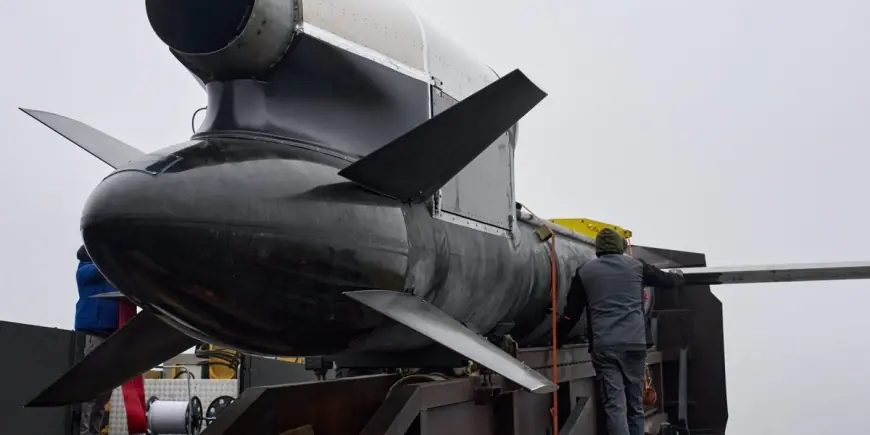
Satellite Imagery has surfaced that appears to show extensive damage to a missile plant in Votkinsk after a long-range Ukrainian strike, while Ukrainian President Volodymyr Zelenskyy says domestically made Flamingo missiles flew the required distances and hit their targets. The images and statements mark a converging set of military, industrial and informational developments that officials and analysts are weighing.
Satellite Imagery of Votkinsk workshop damage
Published images from open-source groups appear to show damage to one of the workshops at the Votkinsk factory, with a gaping hole in the roof and signs of fire damage. The site is identified in reporting as an industrial plant in Votkinsk, Udmurtia, that produces Iskander missiles and Oreshnik missiles. Other coverage describes Votkinsk as a plant that manufactures munitions including ballistic missiles for the Iskander system and the submarine-launched Bulava missile. The images are being used alongside other open-source intelligence and data analysis to document the impact on the facility.
Zelensky’s account of Flamingo missiles and production challenges
President Volodymyr Zelenskyy said Ukraine carried out precise strikes with Flamingo missiles at a range of 1, 400 kilometres and characterized the result as a success for domestic industry. Earlier statements noted that the attack struck a plant in Votkinsk some 860 miles from the Ukrainian border, and one account framed the missiles as flying nearly 900 miles to reach the target. Zelenskyy declined to specify the total number of missiles or drones launched, while saying some were intercepted by Russian air defenses, some were not, and that "most importantly, all missiles that were launched reached the target. " He also said Russian forces are trying to track Flamingo production and that manufacturers will increase output depending on funding and component availability.
What the strike and missile system details reveal
The Flamingo has been compared by Ukrainian officials to longer-established cruise missiles, with one characterization placing the comparable range at 1, 900 miles and noting the missile is turbofan-powered and presented as cheaper per unit. Operational details in available material indicate the ground-launched Flamingo can take up to 40 minutes to prepare for launch. Separate reporting from last October noted the manufacturer FirePoint had hopes of producing up to seven missiles per day by the end of 2025; more recent comments said manufacturing had been affected by a Russian strike and that Ukraine must work on increasing quantity.
Russian and regional responses, casualties and air defenses
Russia has not issued an official confirmation that the Votkinsk facility was hit. Alexander Brechalov, governor of the Udmurt Republic, said an unspecified facility in the region had been attacked and that three people were sent to hospital; he did not confirm the weapon type used and warned against drone threats over the region. Statements attributed to Russian defense authorities said they shot down 77 Ukrainian drones on Saturday but did not mention any missile threats. Kyiv also launched what has been described as a large wave of drones and missiles into Russia in one of its biggest ever long-range attacks on that day.
Parallel military movements, sightings and misinformation concerns
Separately, an American aircraft carrier, USS Gerald R Ford, was observed leaving a port in Greece and departing the island of Crete, appearing to head into the eastern Mediterranean as part of a U. S. military build-up near Iran. Aviation footage shared with analysts shows three F-22 fighter jets taking off from a Suffolk air base on Tuesday; aviation enthusiasts tracked F-22s leaving that base and heading toward Israel. Reporting in a major U. S. newspaper said F-22 fighters were on their way to Israel and that some had already arrived. An expert described the F-22 movement as potentially forming part of an air dominance posture aimed at Iran.
Information operations, verified damage elsewhere and editorial notes
Alongside military reporting, work using open-source intelligence and satellite imagery has also highlighted misinformation: artificial intelligence was used to spread a false claim that a Mexican cartel had captured a woman who helped authorities track down its leader. Verified images have also shown a shopping centre on fire in the Ukrainian city of Zaporizhzhia after a wave of Russian strikes overnight. Coverage and verification efforts have been presented as combining satellite imagery, fact-checking and data analysis to parse complex and fast-moving developments.
Uncertainties and procedural notes
Some details remain unclear in the provided context: Russia has not officially confirmed a strike on the Votkinsk factory; statements differ on exact distances and the number of weapons launched. One item of published material noted that it includes a requirement that online citations link back to its original website when using its materials, and that the item closed with a copyright notice spanning 2015–2026. These images, statements and movements will continue to be assessed as more verification and official comment emerge; details may evolve.