















Liberty Basketball Favored as Flames Visit Kennesaw State in Tight Conference USA Test

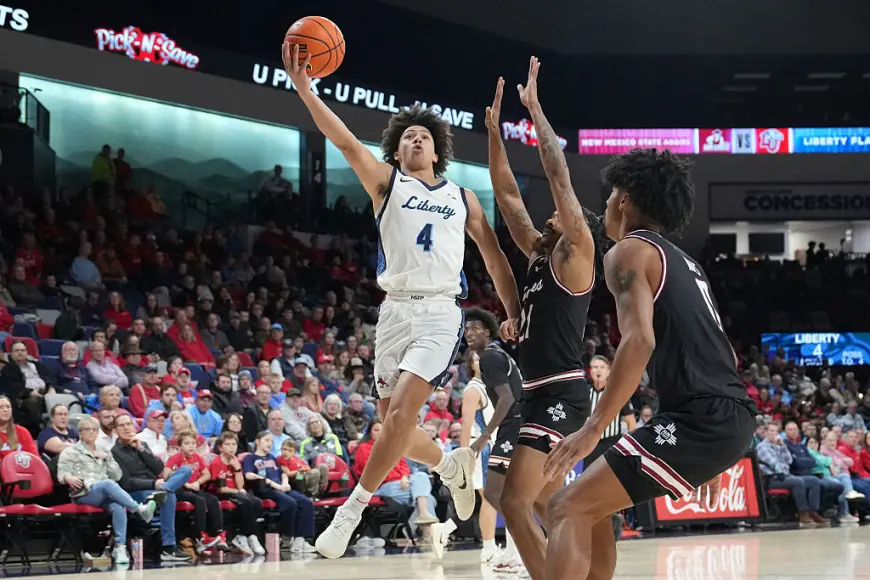
The Liberty Flames travel to Kennesaw on Thursday with conference title implications on the line, and liberty basketball figures to be the deciding factor in a game models call a one-possession tilt. The matchup matters now because Liberty’s 23-4 overall, 15-1 Conference USA ledger keeps it atop the league while Kennesaw State’s 16-11, 8-8 mark makes every home date late in the season consequential.
Liberty Basketball: statistical edge and personnel durability
Liberty’s season-long efficiency underpins its narrow favoritism. The Flames enter the game 23-4 overall and 15-1 in Conference USA, with a four-win record over their last five outings and an offense averaging 78. 4 points in that span. Season metrics show a disciplined ball-handling profile — 8. 9 turnovers per game and a 13. 7% turnover rate — that contributes directly to fewer opponent opportunities and steadier late-possession outcomes. Those numbers help explain why predictive tools give Liberty the edge despite some recent defensive lapses.
Individual production supports the team-level case. Brett Decker Jr. averages 16. 6 points per game while shooting 50. 8% from the field, 48. 1% from three, and 83. 6% from the free-throw line. Colin Porter’s 20-point outing in the recent loss to Western Kentucky highlights his scoring role, and his season free-throw accuracy sits at 91. 5%, a critical asset in close finishes. Zach Cleveland is cited as a stabilizing force when the clock winds down; that late-game reliability is part of why Liberty’s offense is seen as more trustworthy in tight contests.
What makes this notable is that Liberty’s offense has sustained its volume even as the defense has shown cracks: in a 94-73 home loss to Western Kentucky the Flames still shot 55. 6% from the floor, signaling offensive quality that can carry them through erratic defensive stretches.
Kennesaw State: home advantages and recent inconsistencies
Kennesaw State arrives at VyStar Arena with a 16-11 overall record and an even 8-8 mark in conference play. The Owls are a midtable, high-variance unit—scoring 84. 3 points per game on the season but just 2-3 over their last five and 5-5 in their last 10. Home-court dynamics keep the game live: a 35. 7% offensive-rebound rate and a 44. 0 free-throw rate create second-chance and bonus opportunities that can flip close contests in their building.
Recent box-score evidence underscores Kennesaw’s volatility. In the 58-55 win over Louisiana Tech, the Owls shot 35. 1% from the floor, managed only 23. 3% from three, and committed 13 turnovers—numbers that expose how a cold night can neutralize their season scoring average. Those same weaknesses become more consequential against Liberty’s cleaner possession profile and stronger late-possession structure.
Game projection, situational stakes and model outlook
The game is scheduled to tip at 7: 00 PM ET on Thursday at VyStar Arena, and simulation models have rendered a razor-close forecast: a 54% win probability for Liberty and a predicted final score of 77-76. The betting landscape reflects the tight projection—Kennesaw State is listed at +1. 5 for cover probability near 52%, while an over/under set at 152. 5 points carries about a 52% chance of landing under that total. Those figures translate the statistical margins into measurable market expectations and frame what is likely to be a single-possession decision.
The cause-and-effect is straightforward: Liberty’s cleaner ball security and consistent shooting efficiency (evident even in their worst recent loss) reduce turnover-generated and transition scoring chances for opponents, which in turn increases the Flames’ probability of eking out close wins. Conversely, Kennesaw’s strong offensive-rebound and free-throw profiles create extra possessions that can override a single-possession projection if the Owls control the glass and the foul line at home.
With Conference USA positioning at stake—Liberty perched atop the standings and Kennesaw aiming to climb—the matchup should come down to end-of-game execution and which side wins the possession battle. Expect a tight, possession-sensitive contest that models and team metrics both project to be decided in the final minute.