
















Al Green escorted out of State of the Union after holding 'Black people aren’t apes' sign as Democrats refuse to stand for Trump

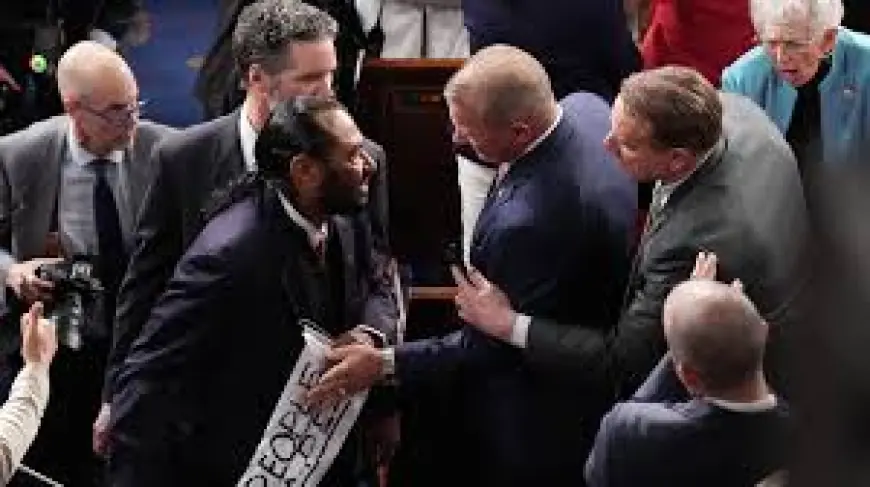
Texas Democrat Al Green was removed from the House chamber almost immediately after brandishing a protest sign reading "Black people aren’t apes!" during the State of the Union, an act that unfolded as many House Democrats remained seated in protest while Republican members repeatedly rose to applaud the president. The early ejection and surrounding confrontations underscore a sharply divided chamber and a continuation of Green’s public opposition to the president.
Al Green escorted from the chamber for silent protest
As the president began his address and most attendees sat, Al Green lingered in the center aisle holding a sign that directly referenced a racist depiction shared by the president of a former first couple. The removal marked the second consecutive year Green was taken out of the annual address; last year he was ordered out by the House speaker, Mike Johnson, for yelling responses during the speech. This year’s action was carried out silently but visibly: Green kept the sign in view as a staffer escorted him from the room.
Aisle confrontations and attempts to block the sign
Multiple Republican representatives tried to grab at Green’s sign or otherwise block it from view of cameras as he was led from the chamber. Representative Troy Nehls engaged aggressively with Green as he passed, and Senator Markwayne Mullin approached him in a menacing manner. As Green walked out clutching both his walking stick and his protest sign, there were acrimonious exchanges and some Republicans began chanting "USA! USA!"
Empty seat and visible message
After Green’s removal, his seat remained empty and a handwritten cardboard sign that said "Al Green" was left in its place. Outside the chamber, Green described his ejection as of no consequence and continued to hold his protest sign for cameras. He said nothing would prevent him from doing what he believed was righteous and that people must take a stand; he added that he was one person who had done so but believed there were many others who would.
Democrats sit or walk out as protest during the speech
Dozens of House Democrats staged a broader protest by remaining seated while Republicans repeatedly stood to applaud the president’s remarks. Several Democrats left the chamber before the speech concluded. A Democratic senator stated on social media that he "couldn't sit through an hour of Trump's lies" and left during the president’s recounting of economic achievements. A Democratic representative said he gave himself "5 bald-faced lies"—the same count as the previous year—before departing less than one hour into the speech.
Voices heard from the Democratic side during the address
During the president’s comments on immigration enforcement and a call for funding for the Department of Homeland Security, some Democratic representatives vocally objected. Representative Rashida Tlaib, wearing a pin that read "release the files", yelled about the killing of Alex Pretti, identified in the chamber as a Minneapolis nurse shot to death by federal agents, shouting that viewers had seen the videos. Representative Ilhan Omar also shouted at the president, telling him he should be ashamed and repeatedly accusing him of having "killed Americans. "
Context on Green’s long-standing opposition
Al Green has been among the president’s most outspoken critics in Congress. He was the first member of Congress to call for the president’s impeachment as early as 2017, represents a predominantly African American district, and has long fought for civil rights. His removal from the State of the Union for a second year in a row continues a pattern of high-profile, confrontational protest from the Texas representative.
Details in this account are drawn from recent coverage of events inside the chamber; some sequences and exchanges were characterized by visible confrontation and public protest, and additional context may continue to emerge.