




Mexico: Violence Erupts After El Mencho Killed as CJNG Strikes Across States

The killing of Nemesio Oseguera Cervantes, known as El Mencho, has triggered an immediate and widespread wave of violence across Mexico that authorities say has included arson, road blockades and deadly clashes. The rapid retaliation from the Jalisco New Generation Cartel (CJNG) has plunged many towns and cities into chaos and prompted security alerts and a heavy response from federal forces.
Mexico sees coordinated reprisal after El Mencho's death
Members of the Jalisco New Generation Cartel unleashed violence across 20 Mexican states in what has been described as direct retaliation for the killing of their leader, Nemesio Oseguera Cervantes. Other accounts place the unrest reaching at least 18 of Mexico's 32 states, demonstrating the abrupt and wide geographic spread of the attacks.
How the operation unfolded: Tapalpa, capture and transport
El Mencho was captured by Mexican special forces in the town of Tapalpa. He was seriously injured in a firefight between his bodyguards and the military commandos deployed to capture him, and he died in custody on Sunday shortly after being captured. He died while military personnel were transporting him from Tapalpa in Jalisco state to the capital, Mexico City. The operation was carried out by Mexican special forces with intelligence support from the US.
CJNG tactics: blockades, arson and mass disruption
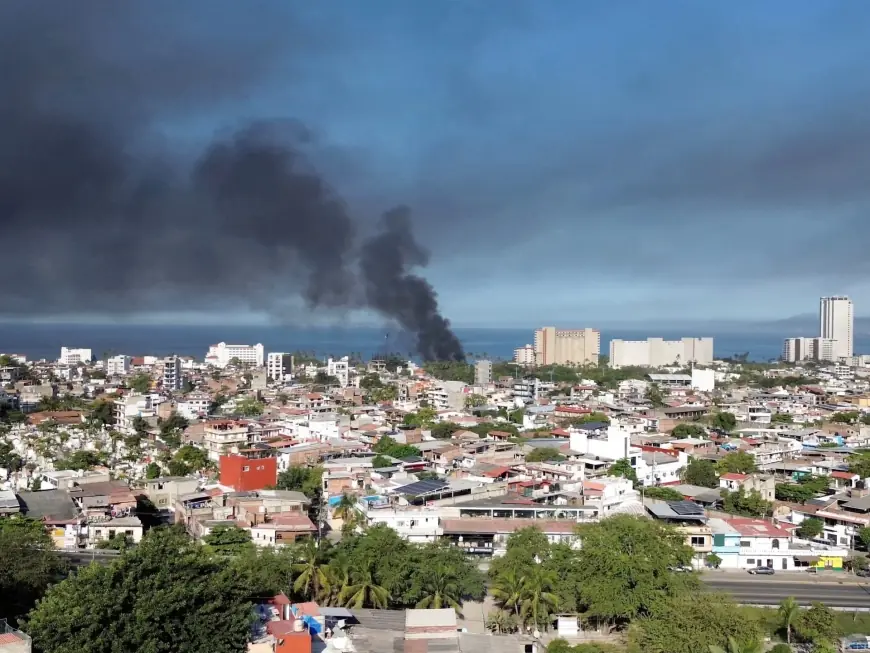
In the immediate aftermath, cartel operatives reportedly blocked roads by throwing spikes and nails onto tarmac, commandeered and torched buses and other vehicles in the middle of streets, and set alight dozens of banks and local businesses, including pharmacies. Footage recorded by locals showed plumes of smoke rising above several towns and the waterfront in the beach resort of Puerto Vallarta, which is popular with tourists.
Casualties, injuries and official security response
The defence ministry said at least six of El Mencho's security guards were killed in the operation, while three members of the Mexican military were injured. Authorities in Jalisco, Michoacan and Guanajuato reported that at least 14 other people were killed in the violence on Sunday, among them seven members of the National Guard. The US Drug Enforcement Administration had placed a $15m reward for El Mencho's capture.
President Claudia Sheinbaum stated there is absolute coordination with the governments of all states and called for people to remain informed and calm. She offered recognition to the Mexican Army, the National Guard, the Armed Forces and the Security Cabinet, and emphasized ongoing efforts for peace, security, justice and the wellbeing of Mexico.
Public panic, vital services disrupted and security alerts
Scenes of panic were reported in Guadalajara, one of the host cities for the forthcoming Fifa World Cup, where travellers at the airport were seen running and crouching on the floor. A news site described panic spreading when a group ran into the terminal seeking shelter after hearing gunshots from a nearby highway; a reporter saw a burnt-out car on that highway and authorities dismissed rumours that shots had been fired inside the terminal. In many towns, streets were deserted as local authorities told residents to shelter in their homes. The US Embassy issued a security alert urging its citizens in Jalisco, Tamaulipas, Michoacan, Guerrero and Nuevo Leon to remain indoors.
Fear, strategy and historical parallels
Residents in affected areas expressed overwhelming fear. A resident of Zitacuaro in Michoacan described how transport networks can be co-opted to block a city's entrances and exits, disrupting hospitals, grocery shopping and deliveries and creating near-total paralysis. Security analyst Edgar Guerra characterized the attacks as a form of criminal communication—actions a criminal order uses when it feels challenged that convey meaning beyond the visible fires and territory.
Observers drew comparisons with 2019 unrest in Sinaloa after the capture of Ovidio Guzmán López; that event produced street battles so fierce that authorities at the time opted to free him to avert further bloodshed. Ovidio Guzmán López, the son of jailed drug kingpin Joaquín "El Chapo" Guzmán, was later re-arrested in 2023 and extradited to the United States, where he pleaded guilty to drug-trafficking charges. Retaliatory attacks by cartels have become a recurring reaction to high-profile arrests, officials and analysts note.
Publisher subscription promotion included in coverage stream
A promotional offer connected to news coverage is highlighting a limited-time subscription deal that ends on 25th February. The promotion references an undefined per-month price and promises complete digital access with exclusive insights and industry deep dives on any device, with the ability to cancel anytime during a trial. The offer states it includes all the content of the newspaper on any device but does not include access to the publisher's main website or app, and it encourages readers to check institutional access through a university or organisation. The promotion notes plans for individuals and organisations, exclusive features for organisational digital access, and that over a million readers subscribe to that newspaper's paid service.
Recent updates indicate events remain fluid and details may evolve as authorities continue operations and investigators assess the full scale of the violence.