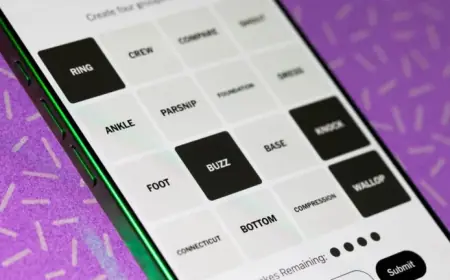
























Connections Answers and Hints for Feb. 16, 2026

Released at midnight ET, today’s Connections puzzle offered a mix of high‑energy themes and a few trickier homophone and emotional groupings. Below you’ll find the four category solutions for Feb. 16, 2026, plus targeted hints and strategy notes for solvers hunting that perfect grid. Spoiler alert: this story contains full answers and explicit hints. If you plan to solve first, stop reading now.
Answers — the four groups and their words
The puzzle sorted the 16 words into four themed groups. From easiest (yellow) to toughest (purple), the completed groups are:
- Yellow (knee‑slapper theme): hoot, laugh, riot, scream
- Green (homophones): do, doe, doh, dough
- Blue (bird sounds): buck, cackle, cluck, squawk
- Purple (stress responses): fawn, fight, flight, freeze
Those four sets wrap up the grid for Feb. 16, 2026. If you were looking for a quick connections hint today: focus first on obvious semantic clusters like emotions and sounds, then isolate homophones and idiomatic groups last.
Hints, patterns and solver strategy
Several design choices made this puzzle memorable. The yellow category leaned on broad synonyms for loud or comic reaction; those were the quickest to spot. The homophone set was deliberately playful, using identical sounds with different spellings and meanings — one of the items even evokes a famous cartoon exclamation. The bird‑sound group mixes both onomatopoeia and less obvious terms that can confuse if you overthink them. Finally, the purple group assembled the four classic stress responses, a theme that’s tidy once the first pair appears.
Practical tips for solvers:
- Start with extremes. Pick items that are emotionally or sonically distinctive; those often form the yellow group.
- When you spot two words that clearly fit together (for example, two words that are homophones or two that describe the same reaction), test them as a pair early. That can collapse the grid and reveal harder categories.
- Don’t ignore unusual words. When one or two items seem to resist obvious grouping, consider narrower themes such as onomatopoeia, stress responses, or homophones rather than broad semantic fields.
- Use the reveal mechanic sparingly. The puzzle’s color levels rank from simplest (yellow) to toughest (purple); revealing one word can confirm a pattern without costing you all that much if you’re close to a complete group.
For players tracking speed and accuracy, the in‑game analysis tool will assign a numeric score and can break down which categories took the most time. Testers rate each puzzle on a five‑point difficulty scale; your personal rating may differ, but comparing your timing on each color can help fine‑tune your approach.
Daily puzzles like this one reward a mix of pattern recognition and swift elimination. If you missed the homophone group, a useful trick is to read candidate words aloud — sound often reveals links that meaning alone disguises. For the stress‑response group, look for verbs and short, action‑oriented terms rather than nouns or sounds.
Want to practice? Try isolating small subsets of the grid and ask whether they share a single, specific trait (sound, emotion, physical action, or a phrase association). That habit helps prevent overbroad guesses and makes it easier to spot the purple‑level themes when they appear.
If you solved the puzzle today, share your time and rating in the comments on your puzzle platform to compare how others approached these categories. For those who didn’t finish, revisit the grid with the four sets above in mind and try grouping again — often a fresh look reveals the last two words almost immediately.