
























Maxim Naumov arrives at Olympics carrying family legacy into men’s event

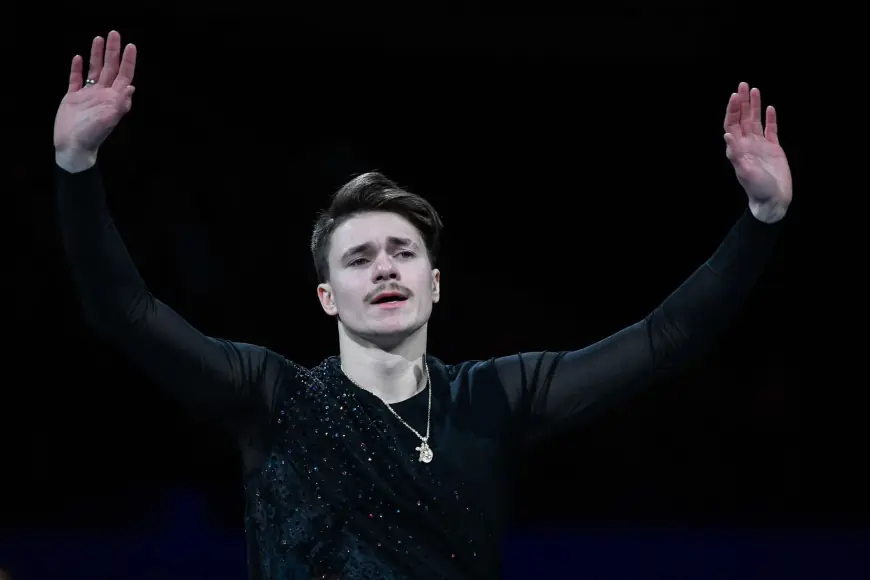
Maxim Naumov’s Olympic moment has arrived with more weight than most debuts. The 24-year-old American men’s singles skater is set to begin his first Winter Games this week in Milan, stepping onto the ice a little more than a year after the deaths of his parents and longtime coaches, Evgenia Shishkova and Vadim Naumov.
His men’s short program is scheduled for Tuesday, Feb. 10 at 12:30 p.m. ET, with the free skate to follow later in the week as the field narrows.
A debut shaped by tragedy and purpose
Naumov’s story has drawn attention well beyond results and rankings because his path to these Games runs through personal loss. His parents—1994 world champions in pairs—died in the January 29, 2025 mid-air collision over the Potomac River near Washington, D.C., a crash that affected the broader figure skating community.
In the months since, Naumov has spoken about skating as both profession and promise: continuing the work his parents invested in him, while trying to build something that is unmistakably his own. That balance is now being tested on the sport’s biggest stage, where every element is judged and every mistake is amplified.
Where he stands heading into Milan
Naumov enters the Olympic competition season as a national bronze medalist, earning his spot after a strong finish at the U.S. championships earlier this year. Internationally, he has posted credible scores on the senior circuit and has shown enough technical base to stay competitive in a deep men’s field that often turns on jump quality, under-rotation calls, and late-program stamina.
His ISU-listed personal bests include an 87.11 short program (set in 2022) and a 151.47 free skate (set in 2025), benchmarks that illustrate both his ceiling and the gap between a clean outing and a medal-level performance in an Olympic year.
The short program: what he needs on Tuesday
The men’s short program is frequently less about winning outright than it is about staying alive. A clean short puts a skater in position to climb; a major error can force a high-risk free skate just to reach the final group.
Naumov’s immediate goals are likely straightforward:
-
Land his planned jumping pass cleanly and avoid costly edge calls.
-
Keep spin levels high enough to protect his base value.
-
Maintain speed and control through the step sequence to avoid grades-of-execution leakage.
The Olympic qualification rule is clear: the top 24 after the short program advance to the free skate. In practical terms, that means Tuesday is about earning the right to skate again with momentum rather than desperation.
Why his technique is under a microscope
Men’s skating in 2026 is shaped by two realities: technical content is exploding, and the judging system can punish small mistakes harshly. For Naumov, the pressure point is not only whether he can land; it’s whether he can land cleanly enough to earn positive grades and avoid calls that chip away at the score.
He has also navigated injuries earlier in his senior career, adding another layer to the discussion around durability and training load. In an Olympic setting with compressed schedules and relentless media attention, the ability to repeat elements under fatigue can matter as much as peak difficulty.
The emotional layer: competing without his parents present
Even by Olympic standards, Naumov is carrying a rare emotional burden: skating at the Games without the two people who coached him through his foundations and understood his habits better than anyone else. The memory of their presence—and the public nature of their absence—has become part of how his routines are perceived.
That reality can cut both ways. Some athletes find clarity in purpose and simplify their execution; others feel the weight in the smallest moments, like waiting for music cues or resetting after a stumble. The first skate often reveals which direction the stress is pulling.
Forward look: what comes after the first skate
The men’s event calendar gives Naumov a path to turn a solid short program into a meaningful Olympic finish. If he advances cleanly, the free skate becomes the place to take calculated risk—either by raising difficulty or by skating to maximize execution.
The larger arc matters, too. A composed Olympic debut can reposition a skater’s career, opening doors for assignments, sponsorship interest, and long-term stability in a sport where momentum is often fragile. For Naumov, a strong week in Milan would also be a public statement that his career is not defined by tragedy, even if it is forever shaped by it.
Key takeaways
-
Maxim Naumov, 24, is scheduled to skate the men’s short program on Feb. 10 at 12:30 p.m. ET.
-
The top 24 after the short program advance to the free skate, making Tuesday’s performance pivotal.
-
His parents and former coaches, Evgenia Shishkova and Vadim Naumov, died in the Jan. 29, 2025 collision over the Potomac River.
-
A clean short program is the main priority: it keeps him in position to build in the free skate rather than chase.
Sources consulted: International Skating Union; Time; ESPN; The Guardian