
























Trump reposts racist Obama “ape” meme, then White House says it was removed

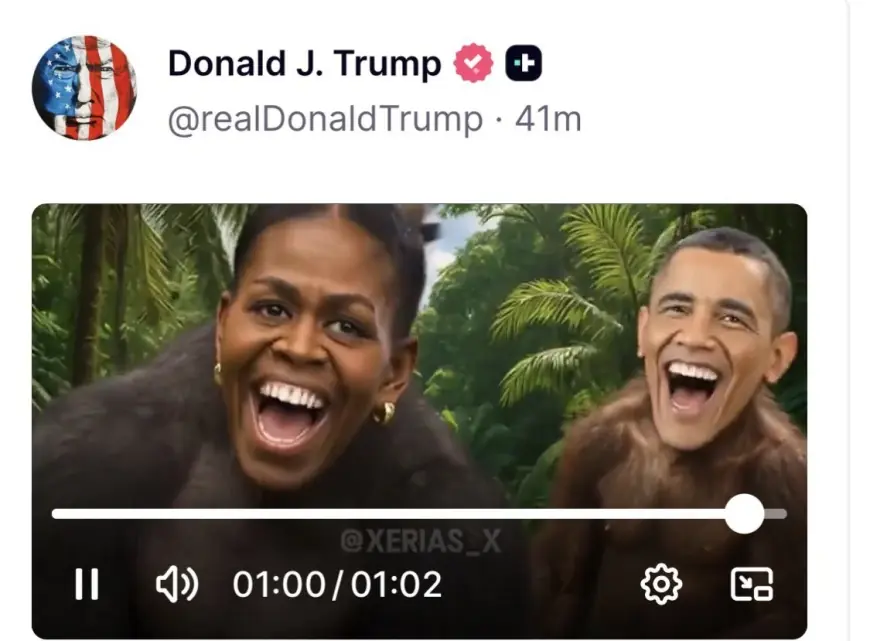
President Donald Trump’s social media account shared a short video late Thursday that depicted former President Barack Obama and former First Lady Michelle Obama as primates—an image long recognized as a racist trope—and paired it with election-fraud conspiracy content. The post drew rapid condemnation from across the political spectrum Friday, Feb. 6, 2026, including from prominent Republicans, and later prompted the White House to say the video had been taken down.
The episode landed during Black History Month and reignited debate over the use of AI-generated and meme-style content in political messaging, especially when it relies on dehumanizing imagery.
What the video showed
The clip was roughly a minute long and largely centered on debunked claims about the 2020 election and voting machines. Near the end, it included a brief scene of two dancing primates with the Obamas’ faces superimposed. The primate segment appeared to be AI-generated or digitally manipulated, and the broader video leaned into a “jungle” theme portraying political figures as animals.
While the primate imagery was on screen only briefly, it dominated the reaction because of its history as a racist symbol used to demean Black people.
What the White House said Friday
Early Friday, the White House press secretary dismissed criticism as “fake outrage” and characterized the post as satire drawn from an internet meme. Hours later, the White House offered a different explanation, saying a staff member posted the video in error and that it was removed.
It remains unclear whether the president personally made the post or whether it was published by a staffer with access to the account. The White House has not publicly provided additional details about internal review, how the content was approved, or what safeguards will be used to prevent similar incidents.
Backlash from Republicans and Democrats
The post drew unusually direct criticism from within Trump’s party. Senator Tim Scott, a South Carolina Republican, called it the most racist thing he had seen from the White House and urged its removal. Representative Mike Lawler, a New York Republican, also condemned the video and called for an apology.
Democrats, civil rights leaders, and advocacy groups denounced the imagery as overtly racist and dehumanizing. The NAACP described the clip as blatantly racist and warned that incidents like this shape voters’ judgments about leadership and values.
The Obamas had not publicly commented by Friday afternoon.
What’s confirmed so far
-
A video featuring the Obamas’ faces superimposed on primates was posted from the president’s social media account late Thursday.
-
The post was tied to election-fraud conspiracy content.
-
Senior Republicans publicly condemned the post and urged its removal.
-
The White House initially defended the post as satire, then later said it was a staff error and the video was removed.
Why the incident is resonating beyond one post
The controversy is not only about offensive imagery. It also highlights how quickly political communication can be shaped by meme culture and AI-assisted edits—tools that can make content more provocative, more shareable, and harder to control once it spreads.
The episode is also part of a broader pattern of fights over online political content: whether leaders should be held responsible for what they repost, how accounts are managed, and how much “it was a meme” can function as an explanation when the content carries racist symbolism.
For critics, the post reinforces concerns about normalizing dehumanizing portrayals for partisan effect. For supporters who saw it as a joke or a jab at opponents, the fallout illustrates the reputational and political costs when provocation crosses widely recognized lines.
What to watch next
The next developments will likely come in three places:
-
A clearer account of responsibility: Whether the White House provides a more detailed explanation of who posted the video and what review process failed.
-
Political follow-through: Whether Republicans who condemned the post press for a formal apology or accept the “staff error” explanation as sufficient.
-
Platform and propagation effects: Even if removed, the clip is likely to continue circulating, raising questions about how campaigns and governments respond when harmful content becomes viral faster than it can be moderated.
For now, the White House faces a dual problem: explaining why the content appeared in the first place and persuading the public that the removal—and the explanation—reflects meaningful accountability rather than damage control.
Sources consulted: Reuters; Associated Press; The Washington Post; ABC News