

























AMD’s Ryzen 9850X3D Review: Enhanced Gaming Power Unveiled

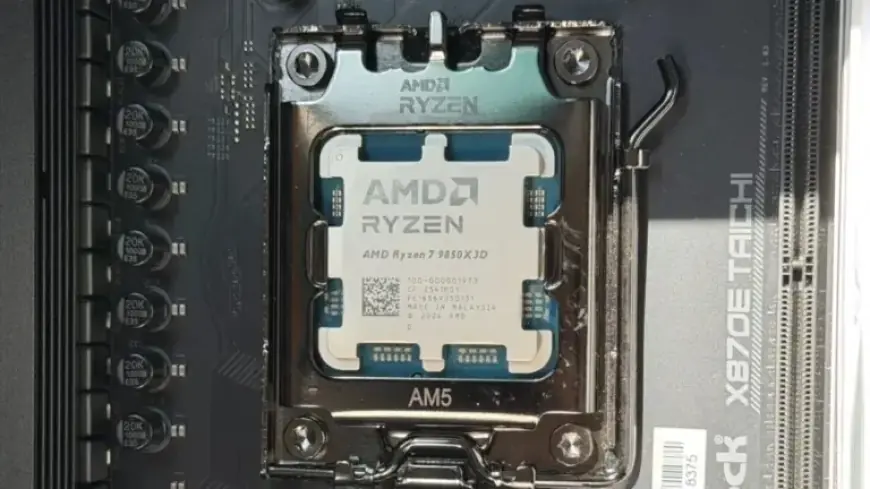
The AMD Ryzen 9850X3D has generated keen interest among gaming enthusiasts. This latest addition to the Ryzen family offers notable improvements in performance and power efficiency compared to its predecessor, the 9800X3D.
Performance Improvements of the Ryzen 9850X3D
In multi-core performance, the Ryzen 9850X3D shows minimal differences from the 9800X3D. Testing revealed that the 9800X3D performs slightly better in specific scenarios, such as video encoding with Handbrake. This variance might stem from differing chip qualities or manufacturing inconsistencies.
However, the 9850X3D shines with its enhanced single-core performance. It narrows the performance gap with higher models like the Ryzen 9900X3D and 9950X3D, both of which lack 3D V-Cache technology. Additionally, it significantly outperforms models without 3D V-Cache, such as the Ryzen 9700X, highlighting its advanced architecture.
Manufacturing Process and Power Consumption
AMD seemingly achieves these performance gains without major architectural changes. Potential reasons may include improved chip selection or advancements in the manufacturing process. However, it appears that these enhancements have led the 9850X3D to function more like a standard non-X3D chip.
Power consumption during gaming is noteworthy. The 9850X3D’s CPU package power reaches 25 to 30 watts higher than the 9800X3D while playing the same titles. Despite the marginal improvements in performance, the increase in power usage raises questions about the efficiency of the upgrade.
- Power Consumption Comparison:
- 9850X3D uses 25-30W more than 9800X3D
- Performance gains remain modest
Despite performance being commendable, the cost-effectiveness of upgrading to the 9850X3D is uncertain. Enthusiasts often seek enhancements where the CPU is the performance bottleneck. While the gaming experience remains impressive, users must weigh the benefits against the increased power requirement and overall cost.
Conclusion
The AMD Ryzen 9850X3D offers improved single-core performance and maintains robust gaming capabilities. However, the higher power consumption and subtle performance gains compared to the 9800X3D pose challenges for consumers considering this upgrade. As always, careful evaluation is essential when investing in new technology.