
























Court Remands White House Ballroom Construction Lawsuit to Lower Court

A federal appeals panel remanded a high-profile construction lawsuit over the White House ballroom to the lower court. The judges said more factual detail is needed to judge how much work can pause without endangering residents and staff.
Order from the appeals court
The U.S. Court of Appeals for the D.C. Circuit returned the case to U.S. District Judge Richard Leon. The panel asked Leon to clarify whether his injunction interferes with safety and security plans.
Leon had issued a March 31 order blocking aboveground work without congressional approval. He temporarily delayed enforcement for two weeks, and the appeals panel extended that pause by three days to April 17.
Security issues at the heart of the dispute
Government lawyers said certain project elements are critical to protect against a range of threats. They listed concerns including drones, ballistic weapons and biohazards.
Officials described below-ground installations as containing fortified protections. The administration said these features include shelters, military-style systems, and a medical facility under the ballroom.
Disagreement over what can proceed
The appeals court noted conflicting government positions. At first, the White House said underground security work could continue separately from the ballroom.
Later filings suggested those upgrades may be inseparable from the overall project. That shift left judges uncertain which tasks can safely continue.
District judge’s ruling and classified review
Judge Leon determined the preservation group was likely to prevail on legal grounds. He said the president lacks statutory authority to build without congressional approval.
Leon exempted any construction needed to protect people. He reached that conclusion after privately reviewing materials the government submitted.
The lawsuit and preservation concerns
The National Trust for Historic Preservation filed suit in December. The group acted about a week after the East Wing was demolished to clear space for a 90,000-square-foot ballroom.
The planned ballroom was described as holding 999 people. National Trust president Carol Quillen said the group seeks clearer answers from the district court.
Approvals, funding and timing
Two oversight bodies that had recently approved the project gave final sign-off shortly after the district ruling. Officials who support the president staffed those agencies.
The administration says aboveground work would begin in April. The president described the ballroom as privately funded, while public funds would cover underground security upgrades.
Appeals panel makeup and dissent
The three-judge panel included Patricia Millett, Neomi Rao and Bradley Garcia. Millett was nominated by President Obama, Rao by President Trump, and Garcia by President Biden.
Judge Rao wrote a dissent. She cited a statute allowing the president to make White House improvements and emphasized ongoing security vulnerabilities.
- Estimated project cost: $400 million.
- Ballroom size: 90,000 square feet (8,400 square meters).
- Capacity claimed by the administration: 999 people.
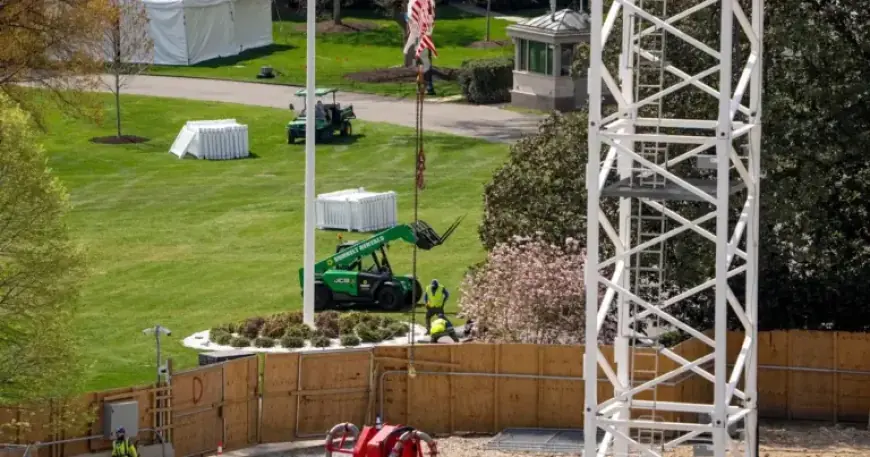
- Photo of construction: March 8, 2026, Aaron Schwartz/Getty Images.
Filmogaz.com will follow further developments as the lower court responds to the appeals panel’s instructions.