






















Royal Navy Tracks Shadow Fleet as Russian Escort Hinders Boarding

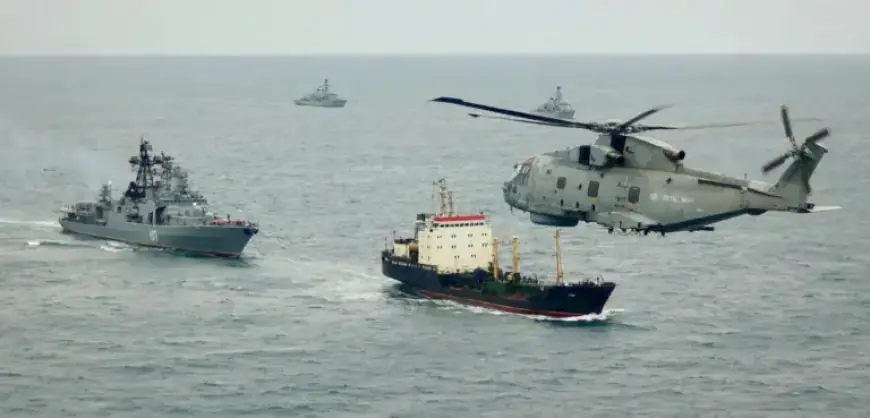
Royal Navy vessels and aircraft have been repeatedly deployed to track increased Russian naval activity in UK waters. The uptick has come as sanctions enforcement has intensified.
Recent patrols and tracking missions
HMS Mersey was tasked on three occasions between 29 March and 7 April. A Wildcat helicopter from 815 Naval Air Squadron and RFA Tideforce supported the ship.
The task group tracked several Russian units. These included the frigate RFS Admiral Grigorovich, landing ship RFS Aleksandr Shabalin, and the Kilo-class submarine RFS Krasnodar.
Monitoring occurred mainly near Ushant and the Dover Strait. Allied aircraft and ships coordinated to maintain continuous awareness as the group moved eastbound through the Channel.
Tankers, escorts and a specific transit
RFA Tideforce monitored two sanctioned tankers, MV Enigma and MV Universal, on 8 April. Both were escorted westwards through the English Channel by RFS Admiral Grigorovich.
Many shadow fleet vessels have diverted around the top of Scotland or west of Ireland. Others transited the Channel under the protection of Russian warships.
Interceptions, handovers and deployments
HMS Somerset intercepted the Udaloy-class destroyer RFS Severomorsk and fleet oiler Kama off Brittany. A Merlin helicopter from 814 Naval Air Squadron supported Somerset during tracking.
HMS St Albans later joined Somerset to conduct a formal handover. Somerset then began a four-month deployment under Operation CETO.
St Albans had completed three months on TAPS duty at the end of March. The rotation highlighted sustained demand on RN units.
Legal powers and practical limits
The UK announced measures in March allowing detention or seizure of vessels suspected of transporting Russian oil. Those powers derive from existing sanctions legislation.
Boarding operations could involve Royal Marines or specialist units. They would also rely on support from warships and other agencies.
Practical challenges remain. Flags of convenience and proximity to international boundaries complicate enforcement at sea.
Escalation risks and changing Russian behaviour
The visible presence of Russian warships raises clear escalation risks. Escorts offer a form of armed overwatch that limits intervention options.
Russian naval escorting of merchant tankers was previously uncommon. The new pattern complicates enforcement without accepting greater risk.
Operational strain on the Royal Navy
Hundreds of shadow fleet vessels are believed to have transited near or through the Channel since the start of the year. This has increased pressure on high-readiness units.
Offshore patrol vessels such as HMS Mersey are working alongside frigates and fleet auxiliaries. Operations are often coordinated with NATO partners.
The Royal Navy can monitor and shadow activity closely. However, large-scale enforcement would need more resources and clear political direction.
Notable past monitoring
HMS Iron Duke monitored RFS Krasnodar during her homeward passage from the Mediterranean in October 2025. That transit was featured in a Channel 5 documentary broadcast on 2 April.
The evolving situation shows why Royal Navy tracks shadow fleet movements while the presence of a Russian escort hinders boarding efforts. Filmogaz.com will continue to follow developments.