

























Olympic Medal Count: Norway’s record gold surge rewrites Winter Games rankings

The Olympic Medal Count for these Milano Cortina Winter Games has become a story about seismic ranking shifts and competing tallies. Norway’s extraordinary gold haul — and the disproportionate share taken by Johannes Høsflot Klæbo — changes how medal tables read at the close of the Games, while differing accounts of totals leave the final leaderboard unclear in the provided context.
Market shift: Norway’s dominance and the ripple effect on standings
Norway finishing at the top of the medal table reframes momentum across the program: its haul is described as both record-setting and broadly dominant, with the country outpacing much larger competitors. That concentration of golds alters comparative performance metrics used to evaluate national programs and will shape how federations judge success from these Games.
Olympic Medal Count: conflicting tallies and the numbers on record
One account presents Norway with 18 golds and 41 total medals, while another lists Norway with 15 golds and 32 total medals. Similarly, the United States appears with differing totals: one set of figures lists 12 golds and 33 total medals for the US, another lists Team USA with 24 total medals and seven golds (placing the team third for total medals). Host nation Italy is shown with 25 total medals and nine golds in one account. These discrepancies mean the precise leaderboard is unclear in the provided context; the differing tallies must be reconciled before a single, authoritative table is accepted.
Standout performances and pivotal moments that shaped the table
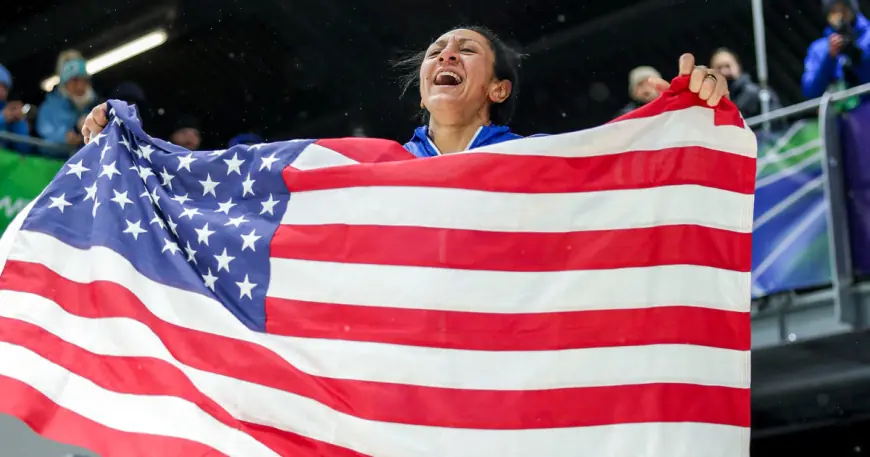
Individual results that fed the medal math are included across accounts. Johannes Høsflot Klæbo accounted for six golds on his own — a return large enough that it exceeds the gold totals of all but seven other countries at these Games. Speedskater Jordan Stolz captured gold in the men’s 1, 000 metres and later added a second gold, each performance described as setting an Olympic record. On Feb. 8 Breezy Johnson won gold in women’s downhill skiing; that win is noted as the second time an American woman has won that event and as her first Olympic medal and the first gold for Team USA at these Games. The same day, Ilia Malinin — also known as the “Quad God” — produced a performance in the figure skating team event that earned Team USA enough points to defeat Japan. On Feb. 11, 20-year-old Elizabeth Lemley won gold in her Olympic debut in women’s moguls, with teammate Jaelin Kauf taking silver. The US men’s hockey program also produced an "incredible gold" moment anchored by Jack Hughes.
Ceremony, spectacle and closing-night color at Verona Arena
The Milano Cortina Winter Olympics concluded at the Verona Arena amid opera, dance and song. The closing show mixed classical and pop elements: a Rigoletto-themed sequence, a performer named Achille belting the song "Amor" (unclear in the provided context whether that identification is definitive), and appearances by high-profile figures filming in the crowd. A performance billed as Major Lazer energized the arena; commentary noted that Italian athletes appeared especially enthusiastic while others seemed more muted. With the ceremony complete, Milano-Cortina is officially over.
- Norway’s population is noted as about 5. 7 million; that figure is cited alongside larger-country populations used for comparison: the United States 342 million, China 1. 4 billion, Germany 84 million, Italy 59 million and Canada 40 million.
- The Netherlands is credited with 10 golds, the same number attributed to host nation Italy in one account; the Netherlands’ population is given as around 18 million.
- Great Britain enjoyed its best-ever Winter Olympics haul with three golds, a silver and a bronze; Australia is likewise credited with three golds, two silver and a bronze.
- Isabel Yip is identified as a news associate (context lists that role; affiliation withheld here).
Here’s the part that matters: the scale of Norway’s golds — and Klæbo’s six — reshapes comparative performance even before a single final tally is settled. What's easy to miss is how concentrated individual excellence can distort national totals: one athlete’s run can move a country multiple places in the standings.
Implications and short signals to watch as numbers are reconciled
The real question now is how governing bodies and statistical outlets reconcile the differing counts. If reconciled totals maintain Norway’s 18 golds and 41 medals, the historical record-setting claim stands; if the lower totals are used, the narrative shifts but Norway still leads in the accounts provided. Confirmation of the definitive medal table and final accounting of individual results (for example, the exact count attributed to Jordan Stolz’s records) will resolve the story’s remaining uncertainty.
Final note: the closing-night color — from opera to pop acts and the USA’s hockey celebration — punctuates a Games that, by the tallies presented here, delivered both national dominance and memorable individual breakthroughs. Recent coverage contains the differing tallies; details may evolve as final reconciliations are completed.