
























Nyc Travel Ban Enforced as Historic Blizzard Slams the US North-East, Airports and Power Grids Struggle

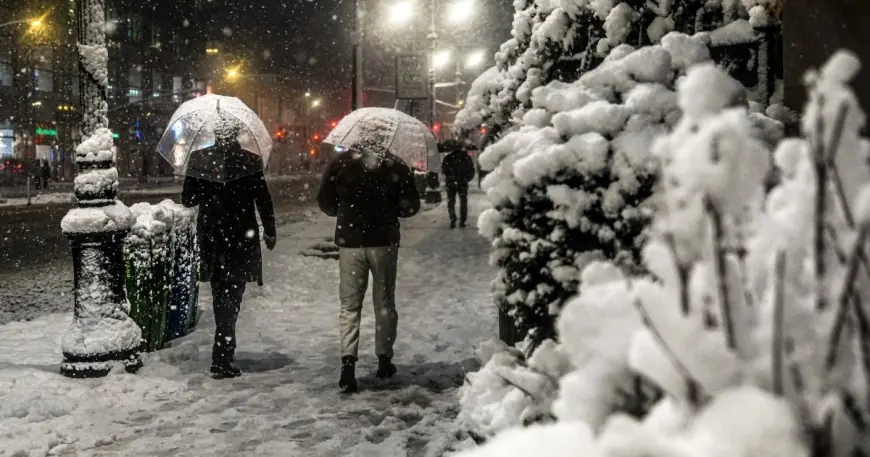
An historic winter storm has triggered a nyc travel ban and widespread emergency measures across the US north-east, placing millions under weather warnings, forcing large-scale flight cancellations and leaving hundreds of thousands without power. The timing and severity of the storm have prompted travel bans, airport suspensions and state-level emergency declarations that will shape response and recovery through the morning.
Nyc Travel Ban: Scope and Timing
A full travel ban in New York City began at 21: 00 local time on Sunday and is set to run until 12: 00 local time on Monday (02: 00–17: 00 GMT window referenced in local statements). The ban closes streets, highways and bridges to all non-emergency traffic and prompted citywide school closures. City emergency officials reiterated that non-essential vehicles must remain off the roads until noon local time, and warming centers are available for vulnerable residents.
Snow totals, intensity and storm footprint
The storm is expected to be the most powerful nor'easter in nearly a decade for much of the region, affecting the US north-east and adjacent maritime provinces from Sunday evening into Monday. Forecast estimates include snowfall rates of 2–3 inches (5–7 cm) per hour at times, with accumulations commonly projected at 1–2 feet (30–60 cm) and localized amounts larger. New York City had seen roughly 9–11 inches of snow early Monday, with local unofficial reports indicating 9–11 inches in Manhattan, 9–12 inches in the Bronx and up to 14 inches in Staten Island. Specific reports elsewhere noted 10 inches (25 cm) in Manorville, New York and 10 inches (25 cm) in Howell, New Jersey.
Air travel and major cancellations
Air travel has been severely disrupted. Flight monitoring services logged thousands of cancellations: one count put cancellations across the United States in the mid-5, 000s on Sunday, while a separate tally for today listed 5, 336 cancellations and 579 delays. At New York-area airports, cancelation tallies include roughly 544 at John F. Kennedy International Airport and about 514 at LaGuardia. Other regional hubs such as Boston Logan, Newark Liberty International and Philadelphia International were also experiencing hundreds of cancellations. John F. Kennedy Airport implemented a full suspension of its AirTrain system overnight; shuttle buses were provided to replace the service at terminals.
Power outages, emergency declarations and official readiness
Officials declared states of emergency in multiple states, including Massachusetts, Connecticut, Delaware, New Jersey and Rhode Island, and the governor placed 100 members of the National Guard on ready alert for statewide response. Power interruptions have escalated: earlier tallies showed more than 150, 000 people without power across the north-eastern states, including about 60, 000 in New Jersey, with tens of thousands more reported in Virginia, Delaware and Maryland. Overnight counts rose further, with utility outages approaching 240, 000 across several states, the highest concentration exceeding 95, 000 customers in New Jersey.
Local services, transit suspensions and institutional closures
Regional transit and institutional responses included full suspensions and closures. NJ Transit suspended train, bus, light rail and access link services until conditions permit gradual resumption. Princeton University closed for non-essential personnel; classes scheduled to begin before noon were advised not to meet in person and an update for afternoon classes was scheduled for 11: 00 a. m. local time, with instructors given the option to move sessions online or reschedule. The severity of coastal wind gusts—expected up to 65–70 mph (104–112 km/h) along parts of the coast—has raised concerns about downed tree limbs and additional power impacts.
What officials say and what comes next
National Weather Service forecasts and local meteorologists emphasized the rarity of a storm of this magnitude across such a populated region; one meteorologist noted it had been several years since an event of comparable size affected this large an area. City leaders warned the most severe snowfall would occur overnight into Monday, with some locations called out for potential accumulations up to 28 inches (70 cm). It is also the first blizzard warning for New York City in nine years. Local leaders tied the emergency to broader public-safety concerns: this is the second major snow event during the current mayor's first term following a deadly cold snap earlier in the year that resulted in 19 deaths over three weeks. A statewide declaration of emergency was announced by the governor, who placed National Guard forces on alert and characterized the storm as an event not seen in years; the governor's public statement ended mid-phrase in available material and is unclear in the provided context.
Details and conditions remain fluid; the storm's impacts on travel, utilities and services may continue to evolve through the day. Officials have stressed that travel restrictions remain in force and that residents should follow emergency guidance.