Bay Area earthquake near San Ramon jolts San Francisco region in Monday-morning swarm

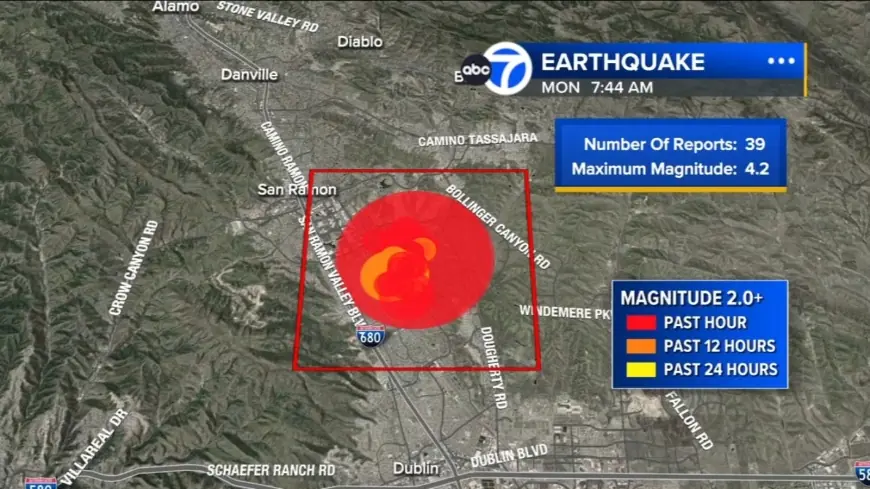
A cluster of earthquakes near San Ramon rattled the San Francisco Bay Area on Monday morning, Feb. 2, 2026, with the strongest registering magnitude 4.2 and triggering brief safety checks on regional transit. The shaking was widely felt across the East Bay and into parts of San Francisco, sending many residents searching for “earthquake today just now” and “earthquake near me.”
Officials said there were no immediate reports of major damage, but the sequence revived attention on a part of the East Bay that has seen repeated bursts of small quakes.
What happened and when
The strongest jolt struck at 10:01 a.m. ET, centered a few miles southeast of San Ramon in Contra Costa County. A second notable tremor hit earlier at 9:27 a.m. ET, part of a larger burst of shaking that began around 9:30 a.m. ET and continued for more than an hour.
The cluster is best described as an earthquake swarm: many quakes of similar size concentrated in the same area over a short period, rather than a single main quake followed by a typical aftershock pattern.
How big was the quake and how many followed
The morning’s largest quake measured 4.2. Another significant event in the same area came in around 3.8 to 3.9. Smaller quakes—mostly in the mid-2s to low-3s—continued through the morning, with tallies rising above 20 events in early counts and above 30 in later preliminary listings as more instruments and analysts logged additional temblors.
Here are the key events most people felt, shown in Eastern Time:
| Time (ET) | Magnitude | Location description |
|---|---|---|
| 9:27 a.m. | 3.8–3.9 | A few miles SE of San Ramon |
| 10:01 a.m. | 4.2 | A few miles SE of San Ramon |
| Late morning | 2.5–3.4 (range) | Same tight cluster near San Ramon |
Where shaking was felt in the Bay Area
Residents reported feeling the quake across a wide footprint, including the East Bay cities of Oakland, Richmond, Hayward, and San Leandro, plus neighborhoods in San Francisco. In many places it registered as a quick, rolling motion or a sharp jolt—enough to rattle windows, shake shelves, and prompt a wave of “earthquake sf” and “sf earthquake just now” searches.
If you’re in the Bay Area and felt a short burst of shaking around 10 a.m. ET, it was likely this San Ramon sequence rather than a separate San Francisco-centered event.
Transit checks and damage reports
Following the stronger quake, Bay Area Rapid Transit temporarily reduced train speeds while crews completed routine track inspections. Riders were told to expect delays that could reach roughly 20 minutes during the checks.
Local officials said they had no immediate indications of significant damage. For quakes in the low-4 range, that outcome is common: they can feel dramatic, especially near the epicenter, but often do not cause major structural impacts—particularly in regions with strict building standards.
What to do if you felt it
For anyone searching “earthquake near me just now,” the most useful next steps are practical, not panicked:
-
Check for hazards at home: look for shifted items, small leaks, and fallen objects.
-
Expect more small shaking: swarms can produce additional bursts, and even minor quakes can knock loose already-unstable items.
-
Review basics: keep shoes and a flashlight near your bed, secure tall furniture, and know how to shut off gas if you smell a leak.
-
Sign up for alerts: U.S. Geological Survey offers notification tools and public “Did You Feel It?” reports that help map where shaking occurred.
A short-term forecast posted for the sequence suggested a moderate chance of additional magnitude-3 shaking and a low chance of another magnitude-4 event in the same area over the near term—another reminder that preparedness matters even when damage is limited.
Sources consulted: U.S. Geological Survey; Associated Press; San Francisco Chronicle; ABC7 Bay Area