























Chappell Roan at the Grammys 2026: The Sheer Mugler “Nipple Ring” Dress That Dominated the Red Carpet Conversation

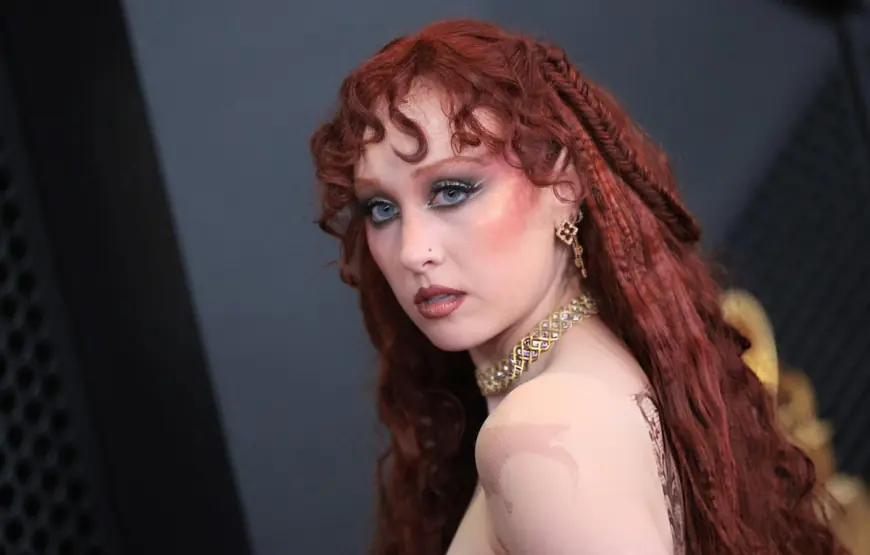
Chappell Roan turned the Grammys 2026 red carpet into a performance piece on Sunday, February 1, 2026, ET, arriving in a sheer maroon Mugler gown engineered to look as if it were draped from nipple rings. The look landed instantly in the center of the night’s fashion narrative, not just for its shock value, but for how precisely it fit Roan’s larger project: pop stardom built as much on visual mythology as on hooks.
Roan’s appearance came with real awards-season stakes. She entered the ceremony nominated for Record of the Year and Best Pop Solo Performance for “The Subway,” a late-blooming hit that helped cement her as one of pop’s most discussed artists. She left the night without those two trophies, as Record of the Year went to Kendrick Lamar and SZA for “Luther,” while Best Pop Solo Performance went to Lola Young for “Messy.” But the red carpet did what it often does in the streaming era: it created its own headline, with its own scoreboard.
Chappell Roan Grammys 2026 outfit: what she wore and how it worked
The dress itself was a study in controlled provocation. From the front, it read as a translucent chiffon column in a deep garnet-maroon shade, with a draped neckline that appeared to hang from ringed points at the chest. From the side and back, it emphasized exposure: backless, minimal, and designed to make the construction part of the message.
The detail that made the look feel less like a stunt and more like stagecraft was the body-art element. Roan paired the gown with an optical-illusion “tattoo” concept that spread across her torso and back, giving the impression of inked skin beneath the sheer fabric. The effect grounded the nude-dress silhouette in character rather than mere reveal, pushing the look into the space Roan likes best: camp, theater, and a little danger.
Styling choices reinforced the intention. Her hair was worn in red-toned braided shapes that leaned fantasy over classic glamour, and the jewelry stayed pointed and deliberate, complementing the dress’s central hardware idea rather than competing with it. A matching wrap or cape element added a removable layer, giving her the ability to shift from red-carpet spectacle to practical movement once cameras moved on.
Who is Chappell Roan, and why this moment fits her brand
Chappell Roan is a pop singer and songwriter who has built a reputation on maximalist aesthetics, bold storytelling, and songs that blur confession with club-ready release. Tracks like “Pink Pony Club” introduced her as an artist unafraid of identity, longing, and spectacle. Over the past year, she has become a major presence in pop’s conversation cycle, winning the kind of devoted fanbase that rewards artists who treat every appearance as part of a larger narrative.
Her Grammys 2026 look made sense in that context. It was not random shock. It was consistent world-building: medieval and mythic references, body art as costume, and a silhouette that turns the body into architecture. In a music industry where attention is the scarce resource, Roan has learned to treat attention as a medium.
Behind the headline: the incentives behind the “nipple ring dress” buzz
Red carpets have become less about fashion and more about distribution. A look that can be summarized in seven words travels farther than one that requires a paragraph. Roan’s outfit had a built-in headline, and that matters because the Grammys now function as a discovery engine: clips, stills, and quick takes that funnel people back to the music.
There is also a competitive incentive. Pop artists are not only competing on chart positions; they are competing on cultural imprint. The nude-dress trend has been everywhere, but Roan’s version escalated it with a clear concept and a recognizable signature. That combination is what turns a dress into a marker of era, not just an outfit.
The stakeholders are broader than fans. Designers and stylists gain visibility from a “can’t ignore it” moment. Award shows benefit from virality that extends beyond the winners list. And the artist benefits most of all when the conversation stays attached to a song title, a tour, and a persona that feels coherent rather than chaotic.
What we still don’t know: the line between engineering and illusion
The public debate tends to fixate on whether the dress was “really” hanging from nipple rings, but the more relevant question is how the illusion was achieved safely and reliably. High-risk fashion moments are usually built on layers of hidden support: transparent base layers, adhesive systems, discreet reinforcement, and choreography that accounts for walking, posing, and lighting.
That’s part of why these looks keep working. The spectacle is visible; the engineering is invisible. And the absence of those details invites endless interpretation, which keeps the story alive.
What happens next: where the conversation goes after Grammys night
Expect the next phase of the story to break into a few predictable lanes:
-
A wave of imitation and escalation as other artists and designers chase similarly headline-ready constructions
-
A backlash cycle focused on decency standards, double standards, and who gets policed for what
-
A pivot back to music, as “The Subway” and “Pink Pony Club” get another surge of curiosity streams
-
A longer-term impact on Roan’s brand as an artist whose visuals are treated as canon, not accessory
The practical takeaway is simple: Chappell Roan did not need a trophy to “win” the night’s attention economy. At the Grammys 2026, she treated the red carpet like a stage, and she left with the thing pop artists fight hardest for now: a moment that people can’t stop replaying.