























jesse jackson, Charismatic Champion of Civil Rights, Dies at 84

The Rev. Jesse Jackson, whose fiery oratory and vision of a multiracial "rainbow coalition" reshaped modern American politics, died Tuesday, Feb. 17, 2026, at his home in Chicago, ET. He was 84. His family released a statement saying he "died peacefully. " In recent months he had been treated for a progressive neurodegenerative condition after publicly disclosing health struggles that included Parkinsonian symptoms.
Legacy: a voice between eras
For a generation that bridged the civil rights struggles of the 1960s and the election of the nation’s first Black president, he was the most visible Black political figure of the intervening decades. Rising from the pulpit to the national stage, he turned pulpit rhetoric into political mobilization and repeatedly urged ordinary Americans to demand a place at the table.
He built a political language that married moral urgency with populist appeals. His calls to "keep hope alive" and his 1980s convention speeches — most notably the galvanizing addresses in 1984 and 1988 — energized a broad progressive constituency and helped define a strand of Democratic politics focused on inclusion and economic justice. He sought the presidency twice, pressing issues of poverty, employment and racial equity into the national conversation even as he fell short of electoral victory.
Jackson's ambition and charisma were inseparable from controversy. Critics and allies alike noted his appetite for attention and the imperfections of a public life lived at high volume. Yet his insistence that the disinherited be heard left a lasting imprint: his organizing helped alter the composition of American politics and opened space for later movements focused on racial justice and economic inequality.
Family, services and final days
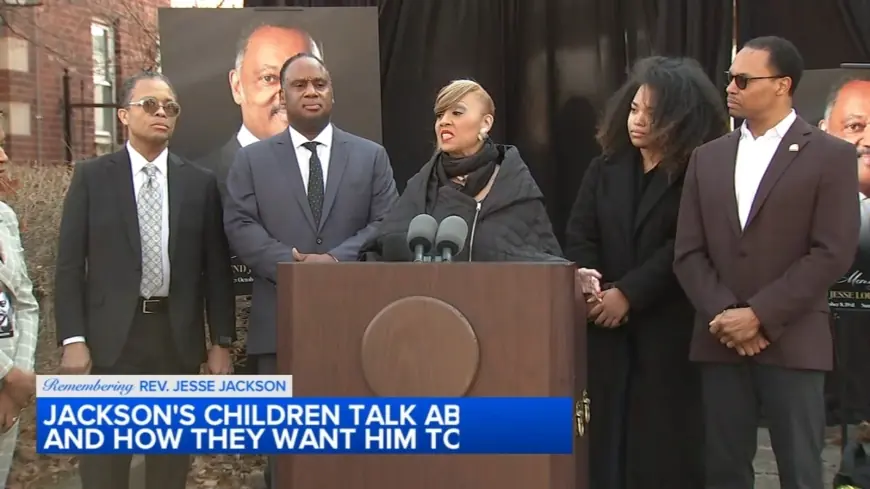
Jackson’s six children publicly gathered in Chicago, standing at the family home to remember their father and outline memorial plans. They described his life as a mission and urged those who admired him to carry his work forward. One son said history would judge him more kindly than his critics did in life; another emphasized that his faith guided his politics.
Public services in Chicago are planned for the coming week. On Wednesday, Feb. 25, there will be a lying in state at his longtime organization’s headquarters at 930 E. 50th St., Chicago, IL 60615. A public celebration of his life is scheduled at the House of Hope at 752 E. 114th St., Chicago, IL 60628. Family members have said funeral events are intended as gatherings for both mourning and calls to action, and they welcome attendees who come out of respect.
In November he was hospitalized for treatment related to a rare and severe neurodegenerative disease. In 2017 he had disclosed a diagnosis of Parkinson’s disease; later health evaluations identified progressive supranuclear palsy, a condition that can profoundly affect movement and speech. Even as his public appearances became less frequent, his organization continued work on voter engagement, economic opportunity and civil rights advocacy.
Enduring influence and contested memory
Jackson’s career defies simple summation. To many, he was a bridge figure who kept alive the radical insistence of the civil rights era while carving a pathway to mainstream political power for communities that had long been marginalized. To others, his outsized personality and lapses from the highest moral standard complicated his legacy.
What remains clear is the scale of his impact: a renewed focus on building cross-racial coalitions, an insistence that moral rhetoric must be paired with political strategy, and a belief in the capacity of ordinary people to remake public life. Leaders and organizers shaped by his example now face the task he left to them — translating moral urgency into durable policy and political power.
He is survived by his wife of more than 60 years and their children, who have asked that mourners reflect on both the accomplishments and the complexities of a life spent in relentless pursuit of change.