

























Doubles Luge Steals the Spotlight at the luge olympics as Italy Sweeps Gold

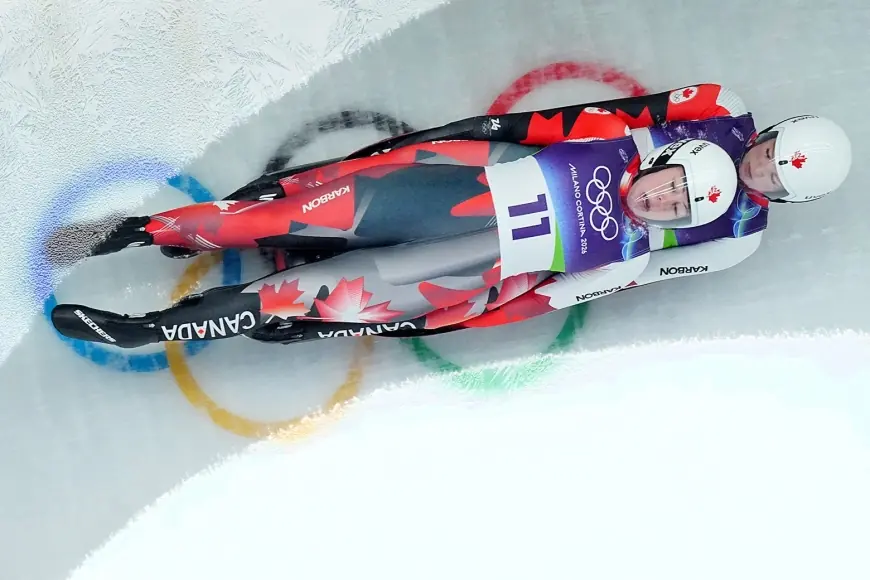
Italy delivered a breakthrough on home ice, winning gold in both men’s and women’s doubles as women’s doubles made its Olympic debut in Cortina d’Ampezzo. Beyond the medals, doubles luge once again became a cultural talking point, blending undeniable athletic precision with an optics problem—or delight—few winter events can match.
Italy Strikes Double Gold on Debut Night
In a landmark moment for the sport, the first-ever women’s doubles event crowned Italian pair Andrea Voetter and Marion Oberhofer as champions. Their performance anchored a banner night for the host nation, which then completed the sweep in the men’s doubles through Emanuel Rieder and Simon Kainzwaldner. For a discipline long seen as a niche within sliding sports, the one-two for Italy delivered both national pride and a jolt of relevance during the high-wattage stretch of the Games.
The results capped an evening in which the field showcased razor-thin margins and track craft that hinge on minute body movements. With women’s doubles now part of the program, the discipline gains fresh competitive depth and a pathway for more athletes to reach the Olympic stage—an expansion that could reshape team strategies and development pipelines heading into future cycles.
How a Two-Person Sled Finds Speed
Doubles luge is frequently misunderstood as a novelty. In reality, it’s a finely tuned collaboration. The bottom athlete lies closest to the sled, absorbing track vibrations and transmitting feel, while the partner above manages the start handles and helps stabilize the sled under extreme G-forces. Steering relies on subtle pressure through shoulders, calves, and toes, where an inch wrong can become a tenth lost. Even the start—those rocking thrusts to build momentum before the push-off—carries real consequences for speed and stability down the chute.
Once moving, the pair becomes a single aerodynamic unit. The upper athlete’s vision aids line choice, but trust is the currency of the craft: both riders must sync their inputs to marry glide with grip. The smallest miscommunication magnifies in the labyrinth of curves, where the fastest line often feels counterintuitive and the bravest runs skate a knife-edge between control and chaos.
The “Two Tobis” and a Running Gag the Internet Can’t Resist
Few duos embody doubles luge like Germany’s Tobias Wendl and Tobias Arlt, longtime standard-bearers and multiple-time Olympic champions from past Games. Their dominance and chemistry have made them both icons and good-humored foils for the sport’s eternal punchline. In a playful pre-Games video circulating among fans, the pair leaned into the innuendo of roles and positions on the sled with a wink—an acknowledgment that doubles luge lives with a perpetual double entendre it can’t, and perhaps shouldn’t, outrun.
The duo’s openness about the silliness alongside the seriousness has helped humanize a sport often seen only through the prism of speed. They may not have been the headline winners on this night, but their shadow loomed large over the conversation as doubles luge once again ricocheted across social feeds.
Top vs. Bottom, or Front vs. Back? The Language Wars
One of the sport’s quirks is its terminology. Many official explanations lean on “front” and “back” to describe the pair. Fans and casual viewers, though, rarely resist the more obvious “top” and “bottom.” The labels carry a joke the internet is only too happy to amplify, even as athletes insist the positions are about function, not innuendo. The upper rider handles the initial pull and sightline, the lower rider delivers sensitivity and stability—two halves of a single sled brain.
This push-and-pull over language mirrors doubles luge itself: it’s both serious and silly, deeply technical yet instantly memeable. With women’s doubles now part of the picture, the conversation widens—and so does the chance to reframe how the roles are understood across the circuit.
Why the Sport Endures—Beyond the Snickers
Strip away the jokes and you’re left with a high-skill, high-stakes event where coordination, fearlessness, and trust determine outcomes measured in hundredths. The athletic demands—core strength at speed, micro-adjustments under pressure, and the capacity to hold a line at the edge of control—place doubles luge among the Games’ most exacting tests. The fact that it also looks outrageous is part of its alchemy. Spectators arrive for the spectacle and stay for the mastery.
On a night when Italy seized the moment and the women’s event carved a new chapter, the luge olympics delivered both podium drama and a cultural sideshow that keeps doubles luge impossible to ignore. If the debut is any indication, the discipline’s next act will be faster, deeper, and—inevitably—just as suggestive.