





Super Bowl halftime show: Bad Bunny headlines Sunday, with culture-forward set expected

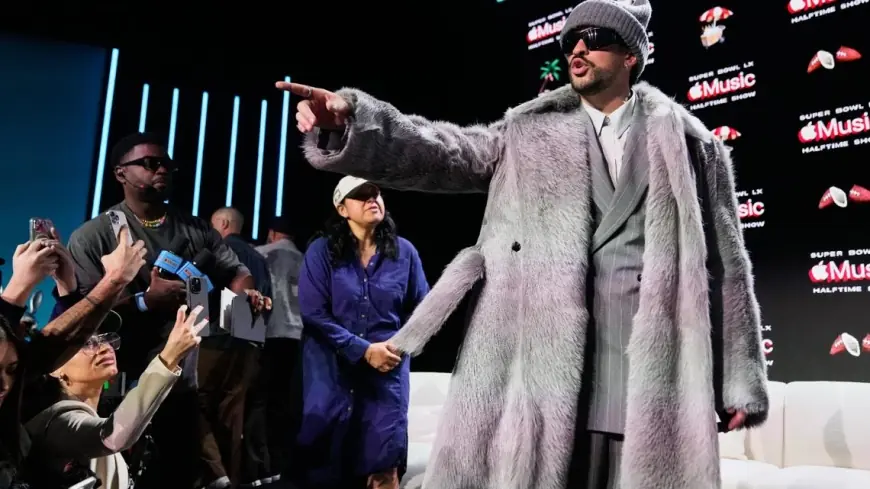
The Super Bowl halftime show takes center stage on Sunday, Feb. 8, 2026 (ET), with Bad Bunny set to headline the performance at Levi’s Stadium in Santa Clara, California. The appearance is a landmark moment for the event’s modern era: he is slated to be the first headliner to perform primarily in Spanish, bringing a global fan base—and a distinctly Caribbean musical palette—to the most-watched night on American television.
The league has kept most production details tightly under wraps, but the broad outline is clear: a short, high-density performance built around his biggest hits, rapid set changes, and at least one “surprise” element that typically defines this stage.
When the halftime show starts in ET
The halftime show’s exact start depends on game flow, but the expected window is familiar: roughly 90–105 minutes after kickoff, once the first half ends.
| Event | Time window (ET) | Notes |
|---|---|---|
| Kickoff | 6:30 PM | Standard Super Bowl kickoff slot |
| Halftime show likely begins | 8:00–8:15 PM | Game-dependent |
| Performance length | ~12–14 minutes | Typical on-field show time |
| Total halftime break | ~25–30 minutes | Includes field build and teardown |
For viewers planning around the performance, the safest approach is to tune in by 7:45 PM ET to avoid missing the opening sequence.
What Bad Bunny is expected to bring to the stage
Bad Bunny’s catalogue is built for a stadium moment: heavy bass drops, chant-ready hooks, and tempo changes that translate to quick, cinematic scene shifts. His live performances also tend to blend reggaeton, Latin trap, pop, and Caribbean rhythms with choreography that reads well on camera.
The creative emphasis this year is widely expected to be cultural and visual—leaning into Puerto Rican identity, Spanish-language dominance, and a “party” energy designed to work both for longtime fans and first-time viewers who only know a chorus or two.
Just as important is the narrative: the halftime show has increasingly become a marker of where mainstream pop culture is headed, and this year’s booking signals that Spanish-language global stardom is no longer treated as a niche lane.
Guest stars: the rumors, and what’s actually confirmed
No guest performers have been publicly confirmed as of Saturday morning ET. That hasn’t stopped speculation, because the halftime show has trained audiences to anticipate at least one surprise cameo—especially for headliners with deep collaboration networks.
Bad Bunny’s most plausible guest pool is large: major collaborators from rap, pop, and Latin music who can enter for one chorus, deliver a short verse, and exit without slowing the pacing. Still, a tight 12–14 minutes limits how many appearances can fit without diluting the headliner’s own set.
Until official confirmation appears, it’s best to treat guest chatter as entertainment rather than a guarantee.
How the production works and why it looks so fast
One reason the halftime show feels like a magic trick is logistics. The field is transformed in minutes: a rolling stage is assembled, lighting towers and sound gear lock into place, and performers hit pre-marked positions with little margin for error. The performance is built for broadcast first—tight shots, planned camera moves, and transitions designed to land on cue.
That’s also why the song choices tend to favor immediate recognition. Halftime sets typically prioritize:
-
biggest hooks
-
clean transitions between tempos
-
crowd-chant moments
-
a “finish strong” finale with the most universal chorus
Bad Bunny’s discography offers plenty of options that fit that formula, especially tracks that are instantly recognizable even if you only know them from snippets.
What to watch for during the show
Three things usually decide whether a halftime performance becomes a classic:
1) The opening 60 seconds. A strong cold open sets the tone and makes casual viewers stay.
2) The mid-set pivot. The best shows change pace once—shifting from pure spectacle into a tighter, musical run.
3) The final chorus. The ending has to feel inevitable: fireworks, a singalong, or a dramatic visual that closes the loop.
This year, the added layer is representation. The show isn’t just a concert—it’s a cultural signal about language, audience, and what “mainstream” now means on the biggest stage.
Sources consulted: Reuters, CBS News, Wikipedia, Apple Newsroom