













Trump’s Obama “ape/monkey” video sparks bipartisan backlash, renewed racism debate, and a scramble over who approved the post

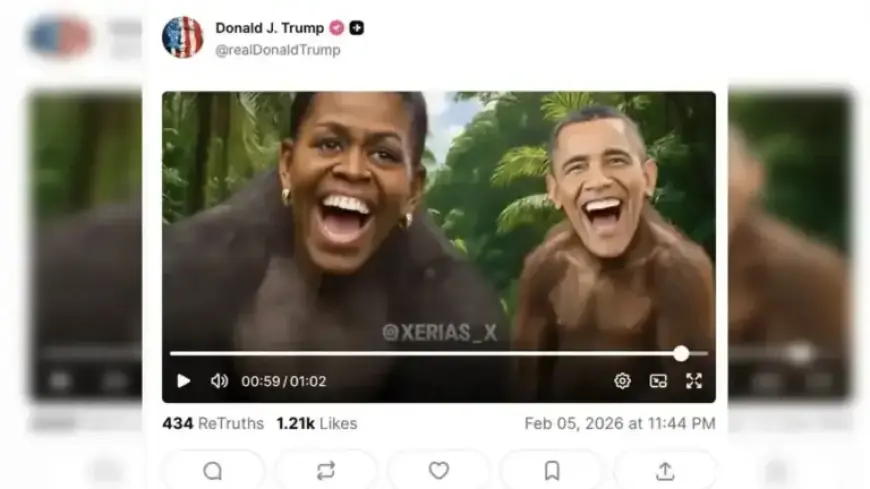
A political firestorm erupted after President Donald Trump shared a short video on his social media feed that included a racially charged depiction of former President Barack Obama and former First Lady Michelle Obama as apes or monkeys. The post, circulated late Thursday night February 5, 2026 ET and removed Friday February 6, triggered condemnation from Democrats and a notable slice of Republicans, plus a wave of cultural figures weighing in as the clip ricocheted across the internet.
By Saturday February 7, 2026 ET, the story has moved beyond the video itself and into a broader question: what it reveals about the incentives of modern political communication, the internal discipline of the White House, and the costs of “own the outrage” posting in an already polarized climate.
What happened: the Trump post, the deletion, and what he said today
The video was framed around familiar election-related claims and meme-style visuals, but it contained a brief segment that superimposed the Obamas’ faces onto primates. The post was widely criticized as racist, drawing on a long history of dehumanizing imagery aimed at Black people.
The White House initially tried to brush off criticism as overreaction to a meme, then the video was removed. Trump later said he did not watch the entire clip before it was shared and suggested he did not see the portion that people found offensive. He has not offered a direct apology to the Obamas as of Saturday.
Why “power posting” keeps happening: incentives and constraints
This episode fits a pattern that has hardened over the past decade: political leaders increasingly use fast, emotionally charged content to dominate attention cycles. The incentive is immediate and measurable. A provocative post can seize the day’s agenda, energize a base, and drown out less favorable headlines.
But the constraint is that the same velocity that makes a post effective also reduces screening. If a video is reposted quickly, the person at the top can claim they missed a detail, while critics argue that the larger message was obvious and intentional. That gap between plausible deniability and perceived intent is where trust erodes.
In this case, timing also mattered. The backlash was amplified by the fact that it landed during Black History Month, turning what might have been dismissed by supporters as “just a meme” into a symbol of something deeper for opponents.
Stakeholders: who gains, who loses, who has leverage
Republican leaders and candidates face a familiar tradeoff. Condemn the post and risk angering a segment of the president’s loyal supporters, or stay silent and risk owning the reputational fallout. Senator Tim Scott’s criticism stood out because it signaled that even within Trump’s party, there are red lines that some are willing to name publicly.
Democratic leaders, including House Minority Leader Hakeem Jeffries, have treated the post as proof of ongoing bigotry and as a mobilizing issue, pressing Republicans to break with Trump rather than normalize the behavior.
The Obamas themselves are central stakeholders but also unusually insulated: they are not running for office, and their public posture has often been to avoid getting dragged into every news cycle. That can frustrate both sides, because it removes the clean, immediate confrontation that partisan media ecosystems tend to reward.
Civil rights groups have leverage by shaping how institutions respond, especially if the controversy bleeds into corporate, donor, or international reputational concerns.
Culture bleeds into politics: Jack White and the wider backlash
The story also widened beyond Washington after musician Jack White posted a sharp public reaction online, calling out the imagery and the behavior behind it. That matters because celebrity intervention changes the audience mix. It pulls in people who might otherwise ignore a Washington dispute and reframes it as a cultural and moral issue rather than a purely partisan one.
Politically, that can raise the temperature. It can also harden the two camps: supporters see elites piling on, critics see accountability spreading.
What we still don’t know: missing pieces that shape accountability
Several questions remain unresolved in practical terms:
Who sourced the clip, and what was the internal review process before it was posted?
Was the video vetted by staff, or shared impulsively and only reviewed after backlash?
What internal consequences, if any, follow a post that required deletion?
Will Republican leadership take any collective step, or will criticism remain individual and fleeting?
Will the White House change policy around reposting third-party content, or treat this as a one-off?
These gaps matter because they determine whether the story is remembered as a scandal with consequences or as another flashpoint that evaporates after a weekend.
Second-order effects: why this could outlast the news cycle
Even if the clip disappears from feeds, its effects linger:
It can deepen distrust among Black voters and moderate swing voters who see the episode as revealing character rather than humor.
It can pressure vulnerable lawmakers to answer uncomfortable questions at home.
It can reshape how outside partners, donors, and institutions assess association risk.
It can normalize a higher “shock threshold,” making future controversies require even more extreme content to break through.
What happens next: plausible scenarios and triggers
A rapid fade-out
Trigger: the White House refuses further comment, allies deflect, and the media cycle pivots.
Sustained pressure and internal tightening
Trigger: more Republicans criticize the post, forcing clearer internal rules on reposting and approvals.
Escalation through retaliation posting
Trigger: Trump doubles down with additional provocative content to reassert control of the narrative.
A broader reckoning on political meme warfare
Trigger: civil rights groups, lawmakers, and cultural figures keep focus on the history behind the imagery, not just the post.
Why it matters
This is not only about one offensive clip. It is a test of whether modern political communication has any functional guardrails when speed and outrage are rewarded. The deletion suggests the backlash had bite. The absence of a clear apology keeps the story alive, because it leaves the central question unresolved: was this a mistake that slipped through, or a signal sent on purpose and pulled back only when the costs became obvious.