















Trump Shares “Apes” Obama Video, Then Pulls It After Backlash—Tim Scott Breaks Ranks as Scrutiny Hits the White House’s Messaging

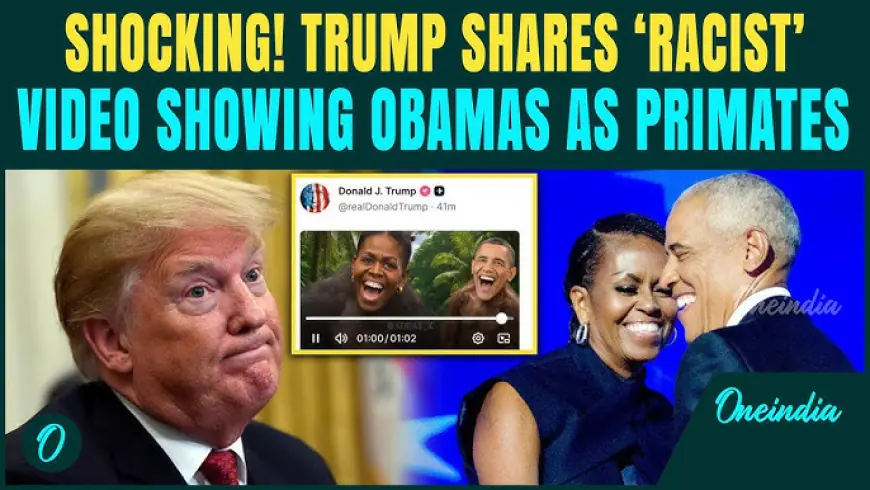
President Donald Trump ignited a political firestorm late Thursday, February 5, 2026, after posting a video on his social media account that depicted former President Barack Obama and former First Lady Michelle Obama with ape imagery—an offensive trope with a long racist history. The post stayed up into Friday morning before it was removed around midday February 6, 2026, after a wave of condemnation that quickly spilled across party lines.
The controversy is not just about what appeared on the president’s feed. It has become a test of how the White House polices digital content, how allies respond when the line is clearly crossed, and how quickly political incentives turn a moment of outrage into a broader battle over race, accountability, and the normalization of extremist meme culture.
What happened, and what the White House said next
The video was posted at approximately 11:44 p.m. ET on February 5. While the clip included familiar false narratives about past elections, the segment that detonated online featured the Obama family portrayed with ape imagery—an element widely recognized as racist and dehumanizing.
By Friday morning, the White House initially brushed off criticism as overblown. Hours later, the post was taken down, with aides signaling it had been put up in error and that the president had not personally reviewed the content before it went live. That shift—dismissal first, deletion later—became its own storyline, raising questions about whether the White House underestimated how politically costly the imagery would be once mainstream scrutiny set in.
Tim Scott’s response is the inflection point
Condemnation from political opponents was immediate, but the more consequential development came from within Trump’s orbit. Senator Tim Scott publicly criticized the post in unusually blunt terms, framing it as overtly racist and unacceptable.
That matters because it breaks a familiar pattern: many allies typically defend the president’s social media controversies as jokes, misinterpretations, or distractions. Scott’s reaction deprived the White House of its usual escape hatch—“only the other side is offended”—and pushed the story from partisan outrage into an internal legitimacy problem.
Behind the headline: why this blew up now
This incident lands at the intersection of three incentives:
-
Attention economics: The president’s online presence thrives on high-velocity engagement. Provocative content is a reliable accelerant, even when it crosses ethical lines.
-
Plausible deniability: The staff-error explanation fits a broader strategy of separating the principal from the post—benefiting from the reach while attempting to outsource responsibility when backlash hits.
-
Coalition management: Republicans have made gains with some demographic groups in recent cycles, but racial provocation threatens that progress and forces allies to choose between loyalty and self-preservation.
The stakeholders extend beyond politicians. Civil rights advocates and community leaders are pushing for consequences and clarity. Media organizations face pressure over how to cover the story without amplifying the imagery. Social platforms and enforcement mechanisms are back in the spotlight. And the public is left trying to parse whether the post reflects an intentional message, a staff lapse, or both.
What we still don’t know
Key details remain unresolved as the story develops:
-
Who posted it: The “staff error” claim raises an obvious follow-up: which staffer, what approval chain, and what safeguards failed?
-
What the president knew and when: If the president didn’t see the content, how was it selected and uploaded from a presidential account without review?
-
Whether there are more similar posts queued or circulating internally: A single post can be an anomaly; a pattern suggests a deliberate editorial environment.
-
Whether any disciplinary action follows: White House accountability rarely looks like private-sector accountability, but the credibility gap grows if “mistake” comes with no visible consequences.
Second-order effects: the ripple impacts beyond one post
This episode has consequences that extend past a single news cycle:
-
Legitimizing fringe imagery: When the president amplifies content with racist tropes, it can normalize what would otherwise remain confined to extremist corners of the internet.
-
Policy distraction with real-world costs: The administration risks losing bandwidth and political capital at a moment when legislative priorities, foreign policy, and economic messaging demand focus.
-
Coalition strain: Allies who rely on broader appeal—especially those sensitive to racial politics—may distance themselves, at least rhetorically, to avoid being tied to the imagery.
-
Institutional trust: The “it was a meme” defense collides with the reality that presidential communication is not casual; it carries symbolic authority and can inflame social tensions.
What happens next: 5 realistic scenarios to watch
-
Internal review and a tighter posting process if the White House decides the blowback is damaging enough to justify new controls. Trigger: continued ally criticism and sustained media attention through the weekend.
-
A formal apology or partial walk-back if the administration tries to reset and contain the political cost. Trigger: additional prominent Republicans publicly rebuke the post.
-
Doubling down as culture-war strategy if the president frames the backlash as censorship or “fake outrage,” turning the controversy into a rallying point. Trigger: supportive reaction from the core base and favorable internal polling.
-
A personnel consequence—quiet reassignment or dismissal—if leadership wants a scapegoat to prove the “staff error” claim. Trigger: persistent demands to name who posted it.
-
A broader debate over presidential communications standards if lawmakers push for oversight of how official accounts are managed. Trigger: evidence of repeated posts of similar nature or a documented lack of review procedures.
Why it matters
The story is not merely that a racist trope appeared online. It’s that it appeared on a presidential account, was initially waved away, and was removed only after backlash hardened—while allies like Tim Scott signaled the line had been crossed. The next phase will hinge on accountability: whether the White House treats this as a one-off mistake or whether it becomes another marker in a long-running argument about how power, race, and digital propaganda intersect in modern American politics.