

























Explore Trinity’s Digital Collections: The Artistic Legacy of St. Brigid

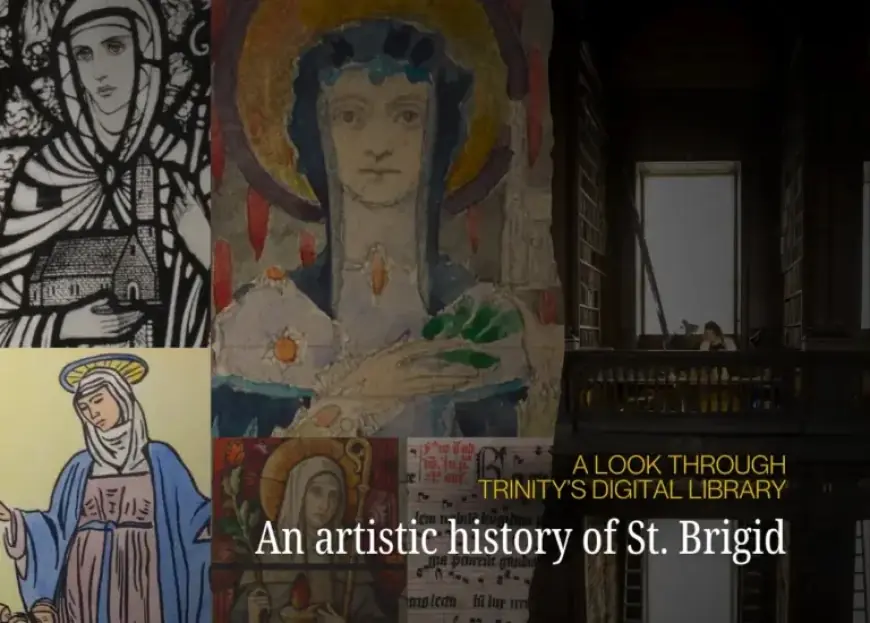
St. Brigid’s Day, also known as Imbolc, is celebrated on February 1. This date marks the beginning of spring in Ireland. The legacy of St. Brigid, intertwined with both pre-Christian and Christian traditions, presents a rich tapestry of cultural history. The digital collections at Trinity College Dublin showcase numerous artistic representations that chronicle her historical significance.
St. Brigid: A Historical Overview
One of the earliest known references to St. Brigid can be found in a 7th-century Old Irish hymn. The Liber Hymnorum, created between the 11th and 12th centuries, is the oldest manuscript housed at Trinity. This manuscript includes a hymn that illustrates Brigid’s connection to the sun and fire, emphasizing her dual nature as a pagan goddess and a Christian saint.
The Legacy of Ultan’s Hymn
Known as Ultan’s Hymn, this work links Brigid to light and goodness. Brigid is celebrated as the Mother of Jesus in various folktales, earning titles such as the “Mary of the Gaels.” She is regarded as a foundational figure alongside St. Patrick in Irish spirituality.
Artistic Representations of St. Brigid
The digital collections of Trinity College include over 200 medieval and early modern Irish manuscripts. These documents highlight the importance of the Irish language, recognized as the oldest vernacular literature in Western Europe.
The Clarke Stained Glass Studios Collection
The Clarke Stained Glass Studios Collection features designs and documentation from stained glass work executed in Dublin from 1893 to 1972. Within this collection are numerous images of St. Brigid that capture her virtues:
- Church and Lambs: A design for a stained glass window.
- Australian Brigid: A design from Cowra, NSW.
- Brigid with a Calf: Showcasing her connection to farming.
- Brigid and the Beggar: Highlighting her charitable acts.
Feast Day Celebrations in the Middle Ages
St. Brigid’s status during the Irish Middle Ages was significant. Her feast day on February 1 was marked by elaborate ceremonies known as “Offices.” These included prayers, music, and readings that celebrated her miraculous deeds.
The Manuscripts and Projects Exploring Brigid’s Influence
Many of these religious documents are preserved in the Manuscripts for Medieval Studies Project and the Virtual Trinity Library of Trinity College. The Amra project, led by Dr. Ann Buckley, investigates the historical context of Irish saints’ offices and their religious significance.
Cuala Press and 20th Century Art
In the early 20th century, St. Brigid was also a subject of inspiration for Cuala Industries, a cooperative founded by Elizabeth and Lily Yeats. The Cuala Press Prints collection at Trinity College contains over 111 hand-coloured prints that feature St. Brigid in various artistic expressions.
Collaborative Research on Cuala Prints
Among these, works by Pamela Colman Smith and modernist Evie Hone stand out as notable representations. The Cuala Press Project aims to conserve and enhance public access to these unique collections.
The Virtual Trinity Library Initiative
The Virtual Trinity Library is a significant initiative to digitize and make accessible the diverse collections at Trinity College Dublin. This project ensures that the artistic legacy of St. Brigid and other significant cultural artifacts are available to a global audience, from students to scholars.
For more information on exploring Trinity’s Digital Collections and the artistic legacy of St. Brigid, visit Filmogaz.com.