
























Maine plane crash: Bangor takeoff tragedy draws focus to de-icing timing, federal records, and victims with Houston ties

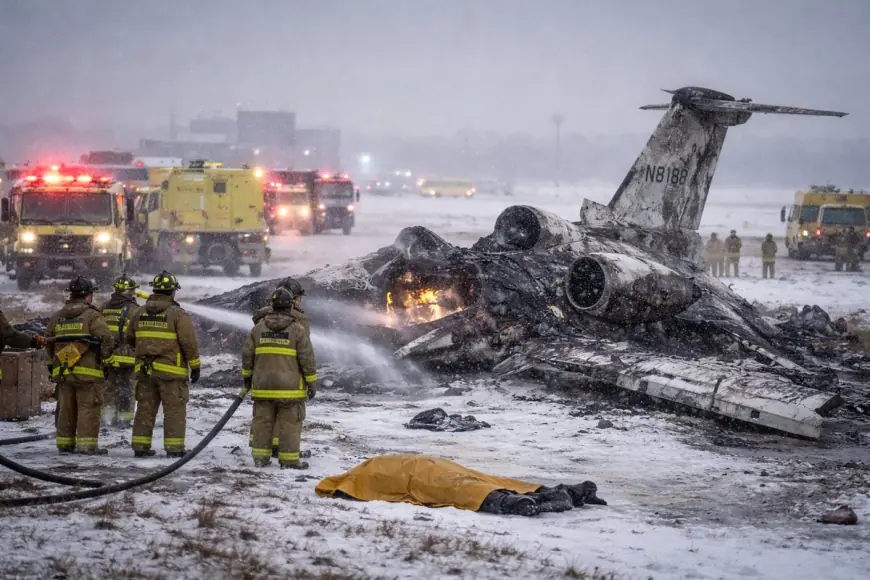
The Maine plane crash at Bangor International Airport has left six people dead after a Bombardier Challenger business jet went down during a snowy takeoff attempt late Sunday, January 25, 2026 ET. The aircraft, a Challenger 600-series jet commonly referred to as a Challenger 650, was preparing to depart Bangor for Europe when it crashed shortly after beginning its departure roll and was consumed by post-crash fire.
Some specifics have not been publicly clarified, including the full list of victims and the exact sequence of technical and operational factors that led to the loss of control.
Bangor plane crash timeline and what is known so far
Authorities have said the Bangor plane crash occurred around 7:45 p.m. ET during bitter cold and active snowfall. The jet involved carried four passengers and two crew members, and none survived. In the hours after the accident, initial public reports contained conflicting counts of people on board, but officials have since aligned on six total.
The airplane is registered in federal records under tail number N10KJ, with the listed owner being a Houston-based entity named KTKJ Challenger LLC. Online chatter has also used a similar name, KTKJ Challenger II LLC, but that alternate name has not been confirmed as the registered owner in the federal listing.
Bangor Airport operations have been disrupted since the crash, with officials indicating the facility would remain closed at least into Thursday morning, January 29, 2026 ET, while investigators work the scene and recovery continues. That timetable can change if investigative needs require additional time.
Tara Arnold, Arnold & Itkin, and other identified victims
The Bangor Maine plane crash has resonated well beyond Maine because several of the identified victims have Houston connections. Tara Arnold, a Houston-based attorney and community figure, has been identified among the deceased. She was married to Kurt Arnold, a co-founder of the Arnold & Itkin law firm, and the aircraft has been publicly linked to an address associated with Arnold and Itkin through the registered owner’s records.
Two other victims who have been publicly identified are Shawna Collins, described as a Houston-area event professional, and Nick Mastrascusa, a chef and hospitality executive with a national profile. The pilot, Jacob Hosmer, has also been publicly identified. Authorities have not yet released all names, and some specifics have not been publicly clarified while identification and notification processes continue.
Search interest in terms like “bangor maine plane crash today,” “plane crash today,” and “houston news” has been driven by the speed of these identifications and the unusual nature of a private jet crash during a high-impact winter weather window.
De-icing, “holdover time,” and what investigators typically examine
Investigators from the National Transportation Safety Board are leading the probe, with the Federal Aviation Administration involved in support. Airport officials have said the jet received fuel and de-icing services prior to departure, which places winter operations at the center of early investigative questions.
Here is the mechanism that usually matters in events like this. In snow and extreme cold, aircraft may be de-iced to remove contamination and then treated with anti-ice fluid designed to delay re-accumulation. That protection is not unlimited. “Holdover time” is the practical window between fluid application and takeoff, and it can shrink dramatically in heavy snow, very low temperatures, and poor visibility. If conditions intensify, an aircraft can require additional treatment or checks before departure.
At this stage, no official cause has been confirmed. Still, investigators typically examine a tight cluster of factors: runway conditions, visibility, wind, aircraft configuration, timing between de-icing and the takeoff attempt, performance data, and any signs of mechanical issues. Some specifics have not been publicly clarified, including the exact de-icing timeline and whether any additional checks were performed immediately before the attempted departure.
Bangor airport impacts: travel disruption, local traffic, and what happens next
The crash has immediate consequences for at least two groups: travelers and airport staff dealing with cancellations and reroutes, and local residents and businesses affected by the airport closure and associated traffic pattern changes near access roads and service areas. There is also a deeper impact on families and coworkers connected to the victims in Maine, Texas, and beyond, as plans for memorials and support efforts unfold.
The next verifiable milestone in the investigation will be the release of a preliminary investigative update, which in major aviation cases often arrives within weeks, followed by a longer final report that can take months. Separately, Bangor International Airport’s stated reopening target of Thursday morning, January 29, 2026 ET is the next operational checkpoint, though officials may revise it depending on scene work and investigative requirements.